Frequency Warping
It is easy to check that the bilinear transform gives a one-to-one,
order-preserving, conformal map [57] between the
analog frequency axis
 and the digital frequency axis
 , where
  is the sampling interval. Therefore, the
amplitude response takes on exactly the same values over both axes,
with the only defect being a
frequency warping such
that equal increments along the unit circle in the
is the sampling interval. Therefore, the
amplitude response takes on exactly the same values over both axes,
with the only defect being a
frequency warping such
that equal increments along the unit circle in the  plane
correspond to larger and larger bandwidths along the
plane
correspond to larger and larger bandwidths along the  axis in
the
axis in
the  plane [88]. Some kind of frequency warping
is obviously unavoidable in any one-to-one map because the analog
frequency axis is infinite while the digital frequency axis is finite.
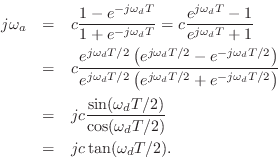
The relation between the analog and digital frequency axes may be
derived immediately from Eq.
plane [88]. Some kind of frequency warping
is obviously unavoidable in any one-to-one map because the analog
frequency axis is infinite while the digital frequency axis is finite.
The relation between the analog and digital frequency axes may be
derived immediately from Eq. (I.9) as
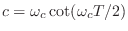
Given an analog cut-off frequency
 , to obtain the
same cut-off frequency in the digital filter, we set
, to obtain the
same cut-off frequency in the digital filter, we set
Next Section:
Analog Prototype Filter
Previous Section:
Bilinear Transformation