







Impulse Response of Repeated Poles
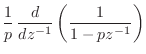
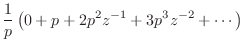
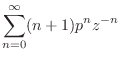
In the time domain, repeated poles give rise to polynomial amplitude envelopes on the decaying exponentials corresponding to the (stable) poles. For example, in the case of a single pole repeated twice, we have

Proof:
First note that

 |
 |
 |
|
|
 |
||
|
 |
||
|
 |
||
|
 |
||
 |
 |
(7.13) |
Note that
 is a first-order polynomial in
  . Similarly, a pole
repeated three times corresponds to an impulse-response component that
is an exponential decay multiplied by a quadratic polynomial in
, and so on. As long as
. Similarly, a pole
repeated three times corresponds to an impulse-response component that
is an exponential decay multiplied by a quadratic polynomial in
, and so on. As long as  , the impulse response will
eventually decay to zero, because exponential decay always overtakes
polynomial growth in the limit as goes to infinity.
, the impulse response will
eventually decay to zero, because exponential decay always overtakes
polynomial growth in the limit as goes to infinity.
Next Section:
So What's Up with Repeated Poles?
Previous Section:
Example











