







Phase Response
Now we may isolate the filter phase response
 by
taking a ratio of the
by
taking a ratio of the  and
and  in Eq.
 (1.5):
![\begin{eqnarray*}
\frac{b(\omega)}{a(\omega)}
&=& -\frac{G(\omega) \sin\left[\...
...eft[\Theta(\omega)\right]}\\
&\isdef & - \tan[\Theta(\omega)]
\end{eqnarray*}](http://www.dsprelated.com/josimages_new/filters/img173.png)
Substituting the expansions of and yields
![\begin{eqnarray*}
\tan[\Theta(\omega)] &=& - \frac{b(\omega)}{a(\omega)} \\
&=&...
...n(\omega T/2)}{\cos(\omega T/2)}
= \tan\left(-\omega T/2\right).
\end{eqnarray*}](http://www.dsprelated.com/josimages_new/filters/img174.png)
Thus, the phase response of the simple lowpass filter
 is
is
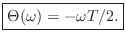
We have completely solved for the frequency response of the simplest low-pass filter given in Eq.
(1.1) using only trigonometric
identities. We found that an input sinusoid of the form


 and the change in
phase at each frequency is given by
and the change in
phase at each frequency is given by  radians. These functions
are shown in Fig.1.7. With these functions at our disposal,
we can predict the filter output for any sinusoidal input. Since, by
Fourier theory [84], every signal can be represented as a sum
of sinusoids, we've also solved the more general problem of predicting the
output given any input signal.
radians. These functions
are shown in Fig.1.7. With these functions at our disposal,
we can predict the filter output for any sinusoidal input. Since, by
Fourier theory [84], every signal can be represented as a sum
of sinusoids, we've also solved the more general problem of predicting the
output given any input signal.
Next Section:
Complex Sinusoids
Previous Section:
Amplitude Response












