Application of the Shift Theorem to FFT Windows
In practical spectrum analysis, we most often use the Fast
Fourier Transform7.15 (FFT) together with a
window function
 . As discussed
further in Chapter 8, windows are normally positive (
. As discussed
further in Chapter 8, windows are normally positive ( ),
symmetric about their midpoint, and look pretty much like a ``bell
curve.'' A window multiplies the signal
),
symmetric about their midpoint, and look pretty much like a ``bell
curve.'' A window multiplies the signal  being analyzed to form a
windowed signal
being analyzed to form a
windowed signal
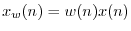 , or
, or
 , which
is then analyzed using an FFT. The window serves to taper the
data segment gracefully to zero, thus eliminating spectral distortions
due to suddenly cutting off the signal in time. Windowing is thus
appropriate when is a short section of a longer signal (not a
period or whole number of periods from a periodic signal).
, which
is then analyzed using an FFT. The window serves to taper the
data segment gracefully to zero, thus eliminating spectral distortions
due to suddenly cutting off the signal in time. Windowing is thus
appropriate when is a short section of a longer signal (not a
period or whole number of periods from a periodic signal).
Theorem: Real symmetric FFT windows are linear phase.
Proof: Let  denote the window samples for
 .
Since the window is symmetric, we have
.
Since the window is symmetric, we have
 for all
  .
When
.
When  is odd, there is a sample at the midpoint at time
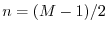 . The midpoint can be translated to the time origin to
create an even signal. As established on page
. The midpoint can be translated to the time origin to
create an even signal. As established on page ![[*]](../icons/crossref.png) ,
the DFT of a real and even signal is real and even. By the shift
theorem, the DFT of the original symmetric window is a real, even
spectrum multiplied by a linear phase term, yielding a spectrum
having a phase that is linear in frequency with possible
discontinuities of
,
the DFT of a real and even signal is real and even. By the shift
theorem, the DFT of the original symmetric window is a real, even
spectrum multiplied by a linear phase term, yielding a spectrum
having a phase that is linear in frequency with possible
discontinuities of  radians. Thus, all odd-length real
symmetric signals are ``linear phase'', including FFT windows.
radians. Thus, all odd-length real
symmetric signals are ``linear phase'', including FFT windows.
When is even, the window midpoint at time lands
half-way between samples, so we cannot simply translate the window to
zero-centered form. However, we can still factor the window spectrum
 into the product of a linear phase term
![$ \exp[-\omega_k(M-1)/2]$](http://www.dsprelated.com/josimages_new/mdft/img1391.png) and a real spectrum (verify this as an
exercise), which satisfies the definition of a linear phase signal.
and a real spectrum (verify this as an
exercise), which satisfies the definition of a linear phase signal.
Next Section:
Normalized DFT Power Theorem
Previous Section:
Zero Phase Signals