Formal Statement of Taylor's Theorem
Let  be continuous on a real interval
  containing
  (and
(and  ),
and let
),
and let
 exist at and
 be continuous for
all
be continuous for
all  . Then we have the following Taylor series expansion:
![\begin{eqnarray*}
f(x) = f(x_0) &+& \frac{1}{1}f^\prime(x_0)(x-x_0) \\ [10pt]
&...
...&+& \frac{1}{n!}f^{(n+1)}(x_0)(x-x_0)^n\\ [10pt]
&+& R_{n+1}(x)
\end{eqnarray*}](http://www.dsprelated.com/josimages_new/mdft/img1874.png)
where
 is called the remainder term. Then Taylor's
theorem [63, pp. 95-96] provides that there exists some
is called the remainder term. Then Taylor's
theorem [63, pp. 95-96] provides that there exists some  between and such that
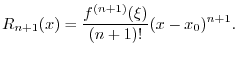
 in , then
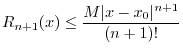 is close to .
When  , the Taylor series reduces to what is called a Maclaurin
series [56, p. 96].
, the Taylor series reduces to what is called a Maclaurin
series [56, p. 96].
Next Section:
Weierstrass Approximation Theorem
Previous Section:
Taylor Series with Remainder