Linear Vector Space
A set of vectors may be called a linear vector space if it is
closed under linear combinations. That is, given any two vectors
 and
and
 from the set, the linear combination
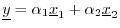
 and
and  . In our
context, most generally, the vector coordinates and the scalars can be
any complex numbers. Since complex numbers are closed under
multiplication and addition, it follows that the set of all vectors in
. In our
context, most generally, the vector coordinates and the scalars can be
any complex numbers. Since complex numbers are closed under
multiplication and addition, it follows that the set of all vectors in
 with complex scalars (
 ) forms a linear vector
space. The same can be said of real length-
) forms a linear vector
space. The same can be said of real length- vectors in
  with
real scalars (
with
real scalars (
 ). However, real vectors with complex
scalars do not form a vector space, since scalar multiplication can
take a real vector to a complex vector outside of the set of real
vectors.
). However, real vectors with complex
scalars do not form a vector space, since scalar multiplication can
take a real vector to a complex vector outside of the set of real
vectors.
Next Section:
Signal Metrics
Previous Section:
Linear Combination of Vectors