Logarithms of Negative and Imaginary Numbers
By Euler's identity,
 , so that

 ,
,
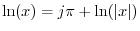 .
.
Similarly,
 , so that

 ,
,
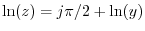 ,
where
,
where  is real.
Finally, from the polar representation
 for
complex numbers,
for
complex numbers,

 and
and  are real. Thus, the log of the magnitude of
a complex number behaves like the log of any positive real number,
while the log of its phase term
are real. Thus, the log of the magnitude of
a complex number behaves like the log of any positive real number,
while the log of its phase term
 extracts its phase
(times
extracts its phase
(times  ).
).
Next Section:
Properties of DB Scales
Previous Section:
Changing the Base