Points of Infinite Flatness
Consider the inverted Gaussian pulse,E.1
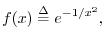
 is the well known Gaussian ``bell curve''
  .
Clearly, derivatives of all orders exist for all
.
Clearly, derivatives of all orders exist for all  . However, it is
readily verified that all derivatives at
. However, it is
readily verified that all derivatives at  are zero. (It
is easier to verify that all derivatives of the bell curve are zero at
are zero. (It
is easier to verify that all derivatives of the bell curve are zero at
 .) Therefore, every finite-order Maclaurin series expansion
of
.) Therefore, every finite-order Maclaurin series expansion
of  is the zero function, and the Weierstrass approximation
theorem cannot be fulfilled by this series.
is the zero function, and the Weierstrass approximation
theorem cannot be fulfilled by this series.
As mentioned in §E.2, a measure of ``flatness'' is the number
of leading zero terms in a function's Taylor expansion (not counting
the first (constant) term). Thus, by this measure, the bell curve is
``infinitely flat'' at infinity, or, equivalently, is
infinitely flat at .
Another property of
 is that it has an
infinite number of ``zeros'' at . The fact that a function
is that it has an
infinite number of ``zeros'' at . The fact that a function
 has an infinite number of zeros at
  can be verified by
showing
can be verified by
showing
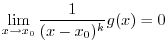
 . For , the existence of an infinite
number of zeros at is easily shown by looking at the zeros of
at , i.e.,
. For , the existence of an infinite
number of zeros at is easily shown by looking at the zeros of
at , i.e.,

 . Thus, the faster-than-exponential decay of a
Gaussian bell curve cannot be outpaced by the factor
. Thus, the faster-than-exponential decay of a
Gaussian bell curve cannot be outpaced by the factor  , for any
finite . In other words, exponential growth or decay is faster
than polynomial growth or decay. (As mentioned in §3.10,
the Taylor series expansion of the exponential function
, for any
finite . In other words, exponential growth or decay is faster
than polynomial growth or decay. (As mentioned in §3.10,
the Taylor series expansion of the exponential function  is
is
 --an ``infinite-order'' polynomial.)
The reciprocal of a function containing an infinite-order zero at
has what is called an essential singularity at
[15, p. 157], also called a
non-removable
singularity. Thus,
 has an essential
singularity at , and
has an essential
singularity at , and  has one at .
An amazing result from the theory of complex variables
[15, p. 270]
is that near an essential singular point
 (i.e.,
  may be
a complex number), the inequality
may be
a complex number), the inequality

 in every neighborhood of
, however small! In other words, the function comes arbitrarily
close to every possible value in any neighborhood about an essential
singular point. This result, too, is due to Weierstrass
[15].
in every neighborhood of
, however small! In other words, the function comes arbitrarily
close to every possible value in any neighborhood about an essential
singular point. This result, too, is due to Weierstrass
[15].
In summary, a Taylor series expansion about the point will
always yield a constant approximation when the function being
approximated is infinitely flat at  . For this reason, polynomial
approximations are often applied over a restricted range of , with
constraints added to provide transitions from one interval to the
next. This leads to the general subject of splines
[81]. In particular, cubic spline approximations
are composed of successive segments which are each third-order polynomials. In each segment,
four degrees of freedom are available (the four polynomial
coefficients). Two of these are usually devoted to matching the
amplitude and slope of the polynomial to one side, while the other two
are used to maximize some measure of fit across the segment. The
points at which adjacent polynomial segments connect are called
``knots'', and finding optimal knot locations is usually a relatively
expensive, iterative computation.
. For this reason, polynomial
approximations are often applied over a restricted range of , with
constraints added to provide transitions from one interval to the
next. This leads to the general subject of splines
[81]. In particular, cubic spline approximations
are composed of successive segments which are each third-order polynomials. In each segment,
four degrees of freedom are available (the four polynomial
coefficients). Two of these are usually devoted to matching the
amplitude and slope of the polynomial to one side, while the other two
are used to maximize some measure of fit across the segment. The
points at which adjacent polynomial segments connect are called
``knots'', and finding optimal knot locations is usually a relatively
expensive, iterative computation.
Next Section:
Differentiability of Audio Signals
Previous Section:
Weierstrass Approximation Theorem