Ideal Gas Law
The ideal gas law can be written as

where
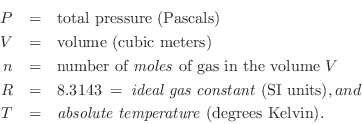
The alternate form  comes from the statistical
mechanics derivation in which
comes from the statistical
mechanics derivation in which  is the number of gas molecules in
the volume, and
is the number of gas molecules in
the volume, and  is Boltzmann's constant. In this
formulation (the kinetic theory of ideal gases), the
average kinetic
energy of the gas molecules is given by
is Boltzmann's constant. In this
formulation (the kinetic theory of ideal gases), the
average kinetic
energy of the gas molecules is given by  . Thus,
temperature is proportional to average kinetic energy of the
gas molecules, where the kinetic energy of a molecule
. Thus,
temperature is proportional to average kinetic energy of the
gas molecules, where the kinetic energy of a molecule  with
translational speed
with
translational speed  is given by
  .
.
In an ideal gas, the molecules are like little rubber balls (or rubbery assemblies of rubber balls) in a weightless vacuum, colliding with each other and the walls elastically and losslessly (an ``ideal rubber''). Electromagnetic forces among the molecules are neglected, other than the electron-orbital repulsion producing the elastic collisions; in other words, the molecules are treated as electrically neutral far away. (Gases of ionized molecules are called plasmas.)
The mass of the gas in volume  is given by
  , where
  is
the molar mass of the gass (about 29 g per mole for air). The
air density is thus
is
the molar mass of the gass (about 29 g per mole for air). The
air density is thus  so that we can write

 is proportional to density
  at constant
temperature
at constant
temperature  (with
(with  being a constant).
We normally do not need to consider the (nonlinear) ideal gas law in
audio acoustics because it is usually linearized about some
ambient pressure  . The physical pressure is then
  , where
 is the usual acoustic pressure-wave variable. That is, we are
only concerned with small pressure perturbations in typical
audio acoustics situations, so that, for example, variations in volume
and density can be neglected. Notable exceptions include
brass instruments which can achieve nonlinear sound-pressure regions,
especially near the mouthpiece [198,52].
Additionally, the aeroacoustics of air jets is nonlinear
[196,530,531,532,102,101].
is the usual acoustic pressure-wave variable. That is, we are
only concerned with small pressure perturbations in typical
audio acoustics situations, so that, for example, variations in volume
and density can be neglected. Notable exceptions include
brass instruments which can achieve nonlinear sound-pressure regions,
especially near the mouthpiece [198,52].
Additionally, the aeroacoustics of air jets is nonlinear
[196,530,531,532,102,101].
Next Section:
Isothermal versus Isentropic
Previous Section:
Energy Decay through Lossy Boundaries