Sign in

username:

password:


Not a member?

Search Online Books


Search tips

Free Online Books


Chapters

Chapter Contents:

Search Physical Audio Signal Processing


Book Index | Global Index


Would you like to be notified by email when Julius Orion Smith III publishes a new entry into his blog?


Lossy Vibration

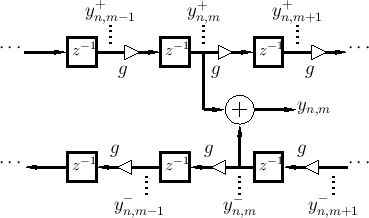
The DW and FDTD state-space models are equivalent with respect to lossy traveling-wave simulation. Figure P.4 shows the flow diagram for the case of simple attenuation by $ g$ per sample of wave propagation, where $ g\in(0,1]$ for a passive string.

Figure P.4: DW flow diagram in the lossy case.
\begin{figure}\input fig/wglossyCopy.pstex_t
\end{figure}

The DW state update can be written in this case as

$\displaystyle \underline{x}_W(n+2) = g^2\mathbf{A}_W\underline{x}_W(n) + {\mathbf{B}_W}\underline{u}(n+2).
$

where the loss associated with two time steps has been incorporated into the chosen subgrid for physical accuracy. (The neglected subgrid may now be considered lossless.) In changing coordinates to the FDTD scheme, the gain factor $ g^2$ can remain factored out, yielding

$\displaystyle \underline{x}_K(n+2) = g^2\mathbf{A}_K\underline{x}_K(n) + \mathbf{B}_K\underline{u}(n+2).
$

When the input is zero after a particular time, such as in a plucked or struck string simulation, the losses can be implemented at the final output, and only when an output is required, e.g.,

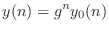
$\displaystyle y(n) = g^n y_0(n)
$

where $ y_0(n)$ denotes the corresponding lossless simulation. When there is a general input signal, the state vector needs to be properly attenuated by losses. In the DW case, the losses can be lumped at two points per spatial input and output [458].


Order a Hardcopy of Physical Audio Signal Processing

Previous: Interior Scattering Junctions
Next: State Space Summary

written by Julius Orion Smith III
Julius Smith's background is in electrical engineering (BS Rice 1975, PhD Stanford 1983). He is presently Professor of Music and Associate Professor (by courtesy) of Electrical Engineering at Stanford's Center for Computer Research in Music and Acoustics (CCRMA), teaching courses and pursuing research related to signal processing applied to music and audio systems. See http://ccrma.stanford.edu/~jos/ for details.


Comments


No comments yet for this page


Add a Comment
You need to login before you can