







Plane Waves in Air
Figure B.9 shows a 2D  cross-section of a snapshot (in time)
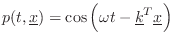
of the sinusoidal plane wave
cross-section of a snapshot (in time)
of the sinusoidal plane wave

 and
and
 , with
  and
and  in the range
  .
.
![\includegraphics[width=\twidth]{eps/planewave}](http://www.dsprelated.com/josimages_new/pasp/img3149.png) |
 , at
, at  with vector wavenumber
![$ \underline{k}^T=[10\pi, 5\pi, 0]$](http://www.dsprelated.com/josimages_new/pasp/img3148.png) .
.Figure B.10 depicts a more mathematical schematic of a sinusoidal plane wave traveling toward the upper-right of the figure. The dotted lines indicate the crests (peak amplitude location) along the wave.
 and
and
 in the
  plane.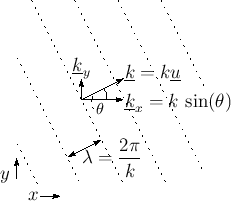
The direction of travel and spatial frequency are indicated by the
vector wavenumber
 , as discussed in in the following section.
Next Section:
Vector Wavenumber
Previous Section:
Air Absorption












