A Signal Processing Perspective on Repeated Mass-Spring Poles
Going back to the poles of the mass-spring system in Eq. (F.39),
we see that, as the imaginary part of the two poles,
(F.39),
we see that, as the imaginary part of the two poles,
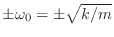 , approach zero, they come together at
  to create a
repeated pole. The same thing happens at
to create a
repeated pole. The same thing happens at
 since
both poles go to ``the point at infinity''.
since
both poles go to ``the point at infinity''.
It is a well known fact from linear systems theory that two poles at
the same point
 in the
  plane can correspond to an
impulse-response component of the form
plane can correspond to an
impulse-response component of the form
 , in addition
to the component
, in addition
to the component
 produced by a single pole at
 . In the discrete-time case, a double pole at
  can
give rise to an impulse-response component of the form
can
give rise to an impulse-response component of the form  .
This is the fundamental source of the linearly growing internal states
of the wave digital sine oscillator at dc and
.
This is the fundamental source of the linearly growing internal states
of the wave digital sine oscillator at dc and  . It is
interesting to note, however, that such modes are always
unobservable at any physical output such as the mass
force or spring force that is not actually linearly growing.
. It is
interesting to note, however, that such modes are always
unobservable at any physical output such as the mass
force or spring force that is not actually linearly growing.
Next Section:
Physical Perspective on Repeated Poles in the Mass-Spring System
Previous Section:
Linearly Growing State Variables in WD Mass-Spring Oscillator