







Conclusions
In summary, only the Blackman window clearly revealed all of the oboe harmonics. This is because the spectral dynamic range of signal exceeded that of the window transform in the case of rectangular and Hamming windows. In other words, the side lobes corresponding to the loudest low-frequency harmonics were comparable to or louder than the signal harmonics at high frequencies.
Note that preemphasis (flattening the spectral envelope using a
preemphasis filter) would have helped here by reducing the spectral
dynamic range of the signal (see §10.3 for a number of
methods). In voice signal processing, approximately  dB/octave
preemphasis is common because voice spectra generally roll off at
dB/octave
preemphasis is common because voice spectra generally roll off at  dB per octave [162]. If
  denotes the original voice
spectrum and
denotes the original voice
spectrum and
 the preemphasized spectrum, then one method
is to use a ``leaky first-order difference''
the preemphasized spectrum, then one method
is to use a ``leaky first-order difference''
 |
(4.30) |
For voice signals, the preemphasized spectrum
 tends to
have a relatively ``flat'' magnitude envelope compared to
tends to
have a relatively ``flat'' magnitude envelope compared to
 . This preemphasis can be taken out (inverted) by the
simple one-pole filter
. This preemphasis can be taken out (inverted) by the
simple one-pole filter
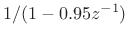 .
.
Next Section:
Matlab for the Bartlett Window:
Previous Section:
Blackman-Windowed Oboe Recording












