Spectrum of Sampled Complex Sinusoid
In the discrete-time case, we replace  by
by  where
where  ranges
over the integers and
ranges
over the integers and  is the sampling period in seconds. Thus,
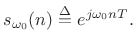
for the positive-frequency component of the sinusoid of the previous
section, we obtain
is the sampling period in seconds. Thus,
for the positive-frequency component of the sinusoid of the previous
section, we obtain
 |
(6.8) |
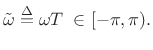
It is common notational practice in signal processing to use normalized radian frequency
 |
(6.9) |
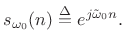
Thus, our sampled complex sinusoid becomes
 |
(6.10) |
It is not difficult to convert between normalized and unnormalized frequency. The use of a tilde (`
 ') will explicitly indicate
normalization, but it may be left off as well, so that
') will explicitly indicate
normalization, but it may be left off as well, so that  may
denote either normalized or unnormalized frequency.6.4
may
denote either normalized or unnormalized frequency.6.4
The spectrum of infinitely long discrete-time signals is given by the Discrete Time Fourier Transform (DTFT) (discussed in §2.1):
 |
(6.11) |
where now
 is an impulse defined for
 or
or
 ,
and
denotes normalized radian frequency. (Treatments
of the DTFT invariably use normalized frequency.)
,
and
denotes normalized radian frequency. (Treatments
of the DTFT invariably use normalized frequency.)
Next Section:
Spectrum of a Windowed Sinusoid
Previous Section:
Spectrum of a Sinusoid