







Stretch/Repeat (Scaling) Theorem
Using these definitions, we can compactly state the stretch theorem:
 |
(3.31) |
Proof:
![\begin{eqnarray*}
\hbox{\sc DTFT}_\omega[\hbox{\sc Stretch}_L(x)]
&\isdef & \sum_{n=-\infty}^{\infty}\hbox{\sc Stretch}_{L,n}(x)e^{-j\omega n}\\
&=& \sum_{m=-\infty}^{\infty}x(m)e^{-j\omega m L}\qquad \hbox{($m\isdef n/L$)}\\
&\isdef & X(\omega L)
\end{eqnarray*}](http://www.dsprelated.com/josimages_new/sasp2/img199.png)
As  traverses the interval
 ,
,
 traverses the unit circle
  times, thus implementing the repeat
operation on the unit circle. Note also that when
times, thus implementing the repeat
operation on the unit circle. Note also that when  , we have
 , so that dc always maps to dc. At half the sampling
rate
, so that dc always maps to dc. At half the sampling
rate
 , on the other hand, after the mapping, we may have
either
, on the other hand, after the mapping, we may have
either
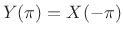 (
odd), or
(
odd), or  (
even), where
(
even), where
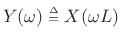 .
.
The stretch theorem makes it clear how to do
ideal sampling-rate conversion for integer upsampling ratios
:
We first stretch the signal by the factor
(introducing  zeros
between each pair of samples), followed by an ideal lowpass
filter cutting off at
zeros
between each pair of samples), followed by an ideal lowpass
filter cutting off at  . That is, the filter has a gain of 1
for
. That is, the filter has a gain of 1
for
 , and a gain of 0 for
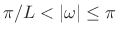 . Such a system (if it were realizable) implements ideal bandlimited interpolation of the original signal by the factor
.
. Such a system (if it were realizable) implements ideal bandlimited interpolation of the original signal by the factor
.
The stretch theorem is analogous to the scaling theorem for continuous Fourier transforms (introduced in §2.4.1 below).
Next Section:
Downsampling and Aliasing
Previous Section:
Repeat (Scaling) Operator












