







Computing the Group Delay of a Filter
I just learned a new method (new to me at least) for computing the group delay of digital filters. In the event this process turns out to be interesting to my readers, this blog describes the method. Let's start with a bit of algebra so that you'll know I'm not making all of this up.
Assume we have the N-sample h(n) impulse response of a digital filter, with n being our time-domain index, and that we represent the filter's discrete-time Fourier transform (DTFT), H(ω), in polar form as:
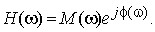 (1)
(1)
In Eq. (1), M(ω) is the frequency magnitude response of the filter, Φ(ω) is the filter's phase response, and ω is continuous frequency measured in radians/second. Taking the derivative of H(ω) with respect to ω, we have:
 (2)
(2)
Dividing Eq. (2) by M(ω), we write:
 (3)
(3)
Performing the derivative of the first term on the right side of Eq. (3) gives us:
 (4)
(4)
 (5)
(5)
So now what does that puzzling gibberish in Eq. (5) tell us? As it turns out, it tells us a lot if we recall the following items:
- jd[H(ω)]/dω = the DTFT of n·h(n)
- M(ω)•ejΦ(ω) = H(ω) = the DTFT of h(n)
- –d[Φ(ω)]/dω = group delay of the filter.
Now we are able to translate Eq. (5) into the meaningful expression
 (6)
(6)
Discretizing expression (6) by replacing the DTFT with the discrete Fourier transform (DFT), we arrive at what I recently learned about computing the group delay of a digital filter:
 (7)
(7)
So, starting with a filter's N-sample h(n) impulse response, performing two N-point DFT's and an N-sample complex division, we can compute the filter's group delay measured in samples. (Of course, to improve our group delay granularity we can zero pad our original h(n) before computing the DFTs). The advantage of the process in expression (7) is that the phase unwrapping process needed in traditional group delay algorithms is not needed here.
WARNING Will Robinson: in implementing the process in expression (7) you must be prepared to accommodate the situation where a frequency-domain DFT[h(n)] sample is zero-valued.
POSTSCRIPT (April 9, 2016)
Recently I was using this group delay estimation method on a 6th-order IIR bandpass filter and my results appeared to be incorrect. As digital filter guru Sanjeev Sarpal pointed out to me, the above group delay estimation method works correctly for FIR filters but not always correctly for IIR filters. In fact, MATLAB's 'grpdelay()' command uses the above scheme for FIR filters, but uses a scheme called "the Shpak algorithm" for IIR filters. So, to be safe, don't use the above scheme for IIR filters.
Below is a bit of MATLAB code that can be used to demonstrate the process in expression (7).clear, clc
Npts = 128; % Number of plotting points
% Define filter feedforward & feedback coefficients
B = [0.03, 0.0605, 0.121, 0.0605, 0.03];
A = [1, -1.194, 0.436];
Imp_Resp_Length = 40;
[Imp_Resp,n] = impz(B,A,Imp_Resp_Length);
ImpResp_times_Time = Imp_Resp.*n;
[Freq_Resp, W] = freqz(Imp_Resp, 1, Npts, 'whole');
[Deriv_of_Freq_Resp, W] = freqz(ImpResp_times_Time, ...
1, Npts, 'whole');
Grp_Delay = real(Deriv_of_Freq_Resp./Freq_Resp);
Grp_Delay = fftshift(Grp_Delay);
Freq = (W-pi)/(2*pi); % Freq axis vector
figure(1), clf
subplot(2,1,1)
plot(n, Imp_Resp, '-ks', ...
n, ImpResp_times_Time, '-bs', 'markersize', 4)
legend('h(n)','n times h(n)');
ylabel('Amplitude'), xlabel('n'), grid on, zoom on
subplot(2,1,2)
plot(Freq, Grp_Delay,'-rs', 'markersize', 4)
ylabel('Group Delay (samples)')
xlabel('Freq x Fs (Fs = sample rate)')
grid on, zoom on- Comments
- Write a Comment Select to add a comment


Please forgive my ignorance. What does "bw i/p&o/p" mean?
For your correlation processing, did you use Matlab software?
[-Rick-]
What you are doing seems sensible to me. If your filter has symmetrical real-valued coefficients, and if the filter's non-zero-valued impulse response is 42 samples in length, then the group delay should be 20.5 (measured in samples). If you send me an e-mail containing a copy of your Matlab code I'll be happy to have a look at it. My e-mail address is . I hope you can see which letters
to delete in the above e-mail address.
[-Rick-]
Can we achieve constant group delay for a "least mean squared adaptive FIR filter"?
I am shamefully ignorant of adaptive filters, so there's not much I can say about them. But if your adaptive FIR filter has symmetrical real-valued coefficients then its group delay should be constant over all frequencies (that is, a linear-phase filter).
[-Rick-]
I did not find your e-mail address in the above message.
Thank you..
[-Kovelapudi prasad-]
I entered my e-mail address in my first reply to you but some web page software deleted it. My e-mail address is: R.Lyons@_delete_ieee.org. I hope you can see which letters
to delete in the above e-mail address.
[-Rick-]
How did u define feedback and feedforward coefficients A and B in the above code.
To post reply to a comment, click on the 'reply' button attached to each comment. To post a new comment (not a reply to a comment) check out the 'Write a Comment' tab at the top of the comments.
Please login (on the right) if you already have an account on this platform.
Otherwise, please use this form to register (free) an join one of the largest online community for Electrical/Embedded/DSP/FPGA/ML engineers:












