







Allpass Examples
- The simplest allpass filter is a unit-modulus gain
where

 can be any phase value. In the real case
can only be 0 or
can be any phase value. In the real case
can only be 0 or  , in which case
 .
.
- A lossless FIR filter can consist only of a single nonzero tap:
for some fixed integer
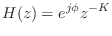
 , where is again some constant phase,
constrained to be 0 or in the real-filter case. Since we are
considering only causal filters here,
, where is again some constant phase,
constrained to be 0 or in the real-filter case. Since we are
considering only causal filters here,  . As a special case of
this example, a unit delay
. As a special case of
this example, a unit delay
 is a simple FIR allpass filter.
- The transfer function of every finite-order, causal,
lossless IIR digital filter (recursive allpass filter) can be written
as
where
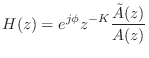 ,
and
,
and

We may think of
 as the flip of
  . For example,
if
. For example,
if
 , we have
 . Thus,
is obtained from by simply reversing the order of the
coefficients and conjugating them when they are complex.
. Thus,
is obtained from by simply reversing the order of the
coefficients and conjugating them when they are complex.
- For analog filters, the general finite-order allpass
transfer function is
where
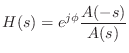 ,
,
 .
The polynomial
.
The polynomial  can be obtained by negating every other
coefficient in , and multiplying by
can be obtained by negating every other
coefficient in , and multiplying by  . In analog, a pure
delay of
. In analog, a pure
delay of  seconds corresponds to the transfer function
which is infinite order. Given a pole
seconds corresponds to the transfer function
which is infinite order. Given a pole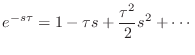
 (root of
  at
at  ),
the polynomial has a root at
),
the polynomial has a root at  . Thus, the poles and
zeros can be paired off as a cascade of terms such as
The frequency response of such a term is
. Thus, the poles and
zeros can be paired off as a cascade of terms such as
The frequency response of such a term is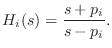 which is obviously unit magnitude.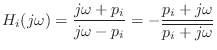
Next Section:
Paraunitary FiltersC.4
Previous Section:
Elementary Filter Problems












