







Definition of a Filter
Thus, a real digital filter maps every real, discrete-time signal to a real, discrete-time signal. A complex filter, on the other hand, may produce a complex output signal even when its input signal is real.
Definition. A real digital filteris defined as any real-valued function of a real signal for each integer
.
We may express the input-output relation of a digital filter by the notation
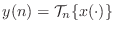
where
 denotes the entire input signal, and
  is the
output signal at time
is the
output signal at time  . (We will also refer to as
simply
. (We will also refer to as
simply  .) The general filter is denoted by
 , which
stands for any transformation from a signal to a sample value at
time . The filter
, which
stands for any transformation from a signal to a sample value at
time . The filter  can also be called an operator on
the space of signals
can also be called an operator on
the space of signals  . The operator maps every signal
 to some new signal
 . (For simplicity, we take
to be the space of complex signals whenever is
complex.) If is linear, it can be called a linear
operator on . If, additionally, the signal space
consists only of finite-length signals, all
. (For simplicity, we take
to be the space of complex signals whenever is
complex.) If is linear, it can be called a linear
operator on . If, additionally, the signal space
consists only of finite-length signals, all  samples long, i.e.,
 or
or
 , then every linear filter
may be called a linear transformation, which is
representable by constant
, then every linear filter
may be called a linear transformation, which is
representable by constant  matrix.
In this book, we are concerned primarily with single-input,
single-output (SISO) digital filters. For
this reason, the input and output signals of a digital filter are
defined as real or complex numbers for each time index (as opposed
to vectors). When both the input and output signals are
vector-valued, we have what is called a
multi-input, multi-out (MIMO) digital filter. We look at MIMO allpass filters in
§C.3 and MIMO state-space filter forms in Appendix G,
but we will not cover transfer-function analysis of MIMO filters using
matrix fraction descriptions [37].
Next Section:
Examples of Digital Filters
Previous Section:
Definition of a Signal












