Analytic Continuation
It turns out that the domain of definition of the Laplace transform can be extended
by means of analytic continuation [14, p. 259].
Analytic continuation is carried out by expanding a function of
 about all points in its domain of definition, and
extending the domain of definition to all points for which the series
expansion converges.
about all points in its domain of definition, and
extending the domain of definition to all points for which the series
expansion converges.
In the case of our exponential example
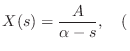 re
re
the Taylor series expansion of
 about the point
  in the
 plane is given by

where, writing as
 and using the chain rule for
differentiation,
and using the chain rule for
differentiation,
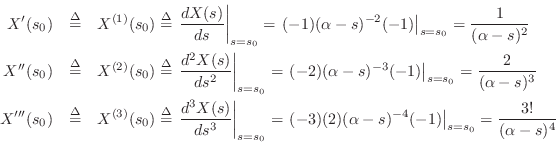
and so on. We also used the factorial notation
 , and we defined the special cases
 and
and
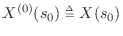 , as is normally done.
The series expansion of can thus be written
, as is normally done.
The series expansion of can thus be written


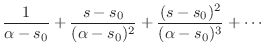
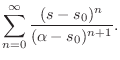
We now ask for what values of does the series Eq. (D.2)
converge? The value
(D.2)
converge? The value  is particularly easy to
check, since
is particularly easy to
check, since
 , no
matter what our choice of
, no
matter what our choice of  might be. We must therefore accept
the point at infinity for
might be. We must therefore accept
the point at infinity for  . This is eminently reasonable
since the closed form Laplace transform we derived,
. This is eminently reasonable
since the closed form Laplace transform we derived,
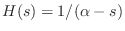 does ``blow up'' at . The point is called a
pole of
.
does ``blow up'' at . The point is called a
pole of
.
More generally, let's apply the ratio test for the convergence
of a geometric series. Since the  th term of the series is

 over
term have absolute value less than
over
term have absolute value less than  . That is, we
require
. That is, we
require

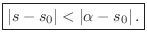 having radius approaching but not equal to
 . Thus, the circular disk of convergence is
centered at and extends to, but does not touch, the
pole at .
. Thus, the circular disk of convergence is
centered at and extends to, but does not touch, the
pole at .
The analytic continuation of the domain of Eq.(D.1) is now
defined as the union of the disks of convergence for all points
 . It is easy to see that a sequence of such disks can
be chosen so as to define all points in the plane except at the
pole .
. It is easy to see that a sequence of such disks can
be chosen so as to define all points in the plane except at the
pole .
In summary, the Laplace transform of an exponential
 is
is
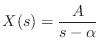
 .
.
Analytic continuation works for any finite number of poles of finite order,D.2 and for an infinite number of distinct poles of finite order. It breaks down only in pathological situations such as when the Laplace transform is singular everywhere on some closed contour in the complex plane. Such pathologies do not arise in practice, so we need not be concerned about them.
Next Section:
Relation to the z Transform
Previous Section:
Existence of the Laplace Transform