







Introduction to Laplace Transform Analysis
The one-sided Laplace transform of a signal  is defined
by
is defined
by
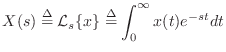
 is real and
 is a complex variable. The
one-sided Laplace transform is also called the unilateral
Laplace transform. There is also a two-sided, or
bilateral, Laplace transform obtained by setting the lower
integration limit to
is a complex variable. The
one-sided Laplace transform is also called the unilateral
Laplace transform. There is also a two-sided, or
bilateral, Laplace transform obtained by setting the lower
integration limit to  instead of 0. Since we will be
analyzing only causalD.1 linear systems using the Laplace transform, we can use
either. However, it is customary in engineering treatments to use the
one-sided definition.
instead of 0. Since we will be
analyzing only causalD.1 linear systems using the Laplace transform, we can use
either. However, it is customary in engineering treatments to use the
one-sided definition.
When evaluated along the  axis (i.e.,
  ), the
Laplace transform reduces to the unilateral Fourier transform:
), the
Laplace transform reduces to the unilateral Fourier transform:
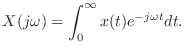
 above), but for causal signals , there is no
difference. We see that the Laplace transform can be viewed as a
generalization of the Fourier transform from the real line (a simple
frequency axis) to the entire complex plane. We say that the Fourier
transform is obtained by evaluating the Laplace transform along the
above), but for causal signals , there is no
difference. We see that the Laplace transform can be viewed as a
generalization of the Fourier transform from the real line (a simple
frequency axis) to the entire complex plane. We say that the Fourier
transform is obtained by evaluating the Laplace transform along the
 axis in the complex
  plane.
An advantage of the Laplace transform is the ability to transform signals which have no Fourier transform. To see this, we can write the Laplace transform as
![$\displaystyle X(s) = \int_0^\infty x(t) e^{-(\sigma + j\omega)t} dt
= \int_0^\infty \left[x(t)e^{-\sigma t}\right] e^{-j\omega t} dt .
$](http://www.dsprelated.com/josimages_new/filters/img1668.png)
 (the so-called ``strict right-half plane'' (RHP)), this
exponential weighting forces the Fourier-transformed signal toward
zero as
(the so-called ``strict right-half plane'' (RHP)), this
exponential weighting forces the Fourier-transformed signal toward
zero as
 . As long as the signal does not increase
faster than
. As long as the signal does not increase
faster than  for some
  , its Laplace transform will exist for all
 . We make this more precise in the next section.
Existence of the Laplace Transform
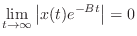
A function has a Laplace transform whenever it is of
exponential order. That is, there must be a real number
such that
 has a
Laplace transform for all finite values of
has a
Laplace transform for all finite values of  and
and  . Let's
look at this case more closely.
. Let's
look at this case more closely.
The Laplace transform of a causal, growing exponential function
![$\displaystyle x(t) = \left\{\begin{array}{ll}
A e^{\alpha t}, & t\geq 0 \\ [5pt]
0, & t<0 \\
\end{array}\right.,
$](http://www.dsprelated.com/josimages_new/filters/img1674.png)
![\begin{eqnarray*}
X(s) &\isdef & \int_0^\infty x(t) e^{-st}dt
= \int_0^\infty A...
...alpha \\ [5pt]
\infty, & \sigma<\alpha \\
\end{array} \right.
\end{eqnarray*}](http://www.dsprelated.com/josimages_new/filters/img1675.png)
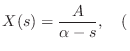
Thus, the Laplace transform of an exponential
is
 , but this is defined only for
re
, but this is defined only for
re .
.
Analytic Continuation
It turns out that the domain of definition of the Laplace transform can be extended
by means of analytic continuation [14, p. 259].
Analytic continuation is carried out by expanding a function of
 about all points in its domain of definition, and
extending the domain of definition to all points for which the series
expansion converges.
about all points in its domain of definition, and
extending the domain of definition to all points for which the series
expansion converges.
In the case of our exponential example
 re
re
the Taylor series expansion of
 about the point
  in the
plane is given by
in the
plane is given by

where, writing as
 and using the chain rule for
differentiation,
and using the chain rule for
differentiation,
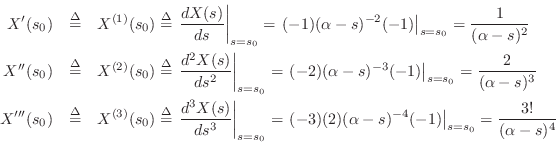
and so on. We also used the factorial notation
 , and we defined the special cases
 and
and
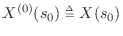 , as is normally done.
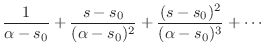
The series expansion of can thus be written
, as is normally done.
The series expansion of can thus be written


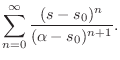
We now ask for what values of does the series Eq. (D.2)
converge? The value
(D.2)
converge? The value  is particularly easy to
check, since
is particularly easy to
check, since
 , no
matter what our choice of
, no
matter what our choice of  might be. We must therefore accept
the point at infinity for
might be. We must therefore accept
the point at infinity for  . This is eminently reasonable
since the closed form Laplace transform we derived,
. This is eminently reasonable
since the closed form Laplace transform we derived,
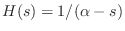 does ``blow up'' at . The point is called a
pole of
.
does ``blow up'' at . The point is called a
pole of
.
More generally, let's apply the ratio test for the convergence
of a geometric series. Since the  th term of the series is

 over
term have absolute value less than
over
term have absolute value less than  . That is, we
require
. That is, we
require

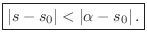 having radius approaching but not equal to
 . Thus, the circular disk of convergence is
centered at and extends to, but does not touch, the
pole at .
. Thus, the circular disk of convergence is
centered at and extends to, but does not touch, the
pole at .
The analytic continuation of the domain of Eq.(D.1) is now
defined as the union of the disks of convergence for all points
 . It is easy to see that a sequence of such disks can
be chosen so as to define all points in the plane except at the
pole .
. It is easy to see that a sequence of such disks can
be chosen so as to define all points in the plane except at the
pole .
In summary, the Laplace transform of an exponential
 is
is
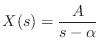
 .
.
Analytic continuation works for any finite number of poles of finite order,D.2 and for an infinite number of distinct poles of finite order. It breaks down only in pathological situations such as when the Laplace transform is singular everywhere on some closed contour in the complex plane. Such pathologies do not arise in practice, so we need not be concerned about them.
Relation to the z Transform
The Laplace transform is used to analyze continuous-time
systems. Its discrete-time counterpart is the  transform:
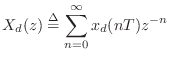
 , the transform becomes proportional to the
Laplace transform of a sampled continuous-time signal:
, the transform becomes proportional to the
Laplace transform of a sampled continuous-time signal:
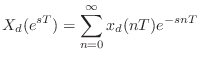
 goes to zero, we have

 and
and
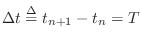 .
.
In summary,

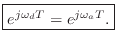
Note that the plane and plane are generally related by

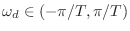 and
continuous-time frequency axis
and
continuous-time frequency axis
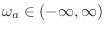 are related
by
are related
by
 from the plane to the
plane to be invertible, it is necessary that
from the plane to the
plane to be invertible, it is necessary that
 be zero for all
 . If this is true, we say
is
bandlimited to half the sampling rate. As is well known, this
condition is necessary to prevent aliasing when sampling the
continuous-time signal at the rate
. If this is true, we say
is
bandlimited to half the sampling rate. As is well known, this
condition is necessary to prevent aliasing when sampling the
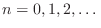
continuous-time signal at the rate  to produce
 ,
,
 (see [84, Appendix G]).
Laplace Transform Theorems
Linearity
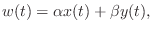
The Laplace transform is a linear operator. To show this, let
 denote a linear combination of signals and
  ,
,
 and
and  are real or complex constants. Then we have
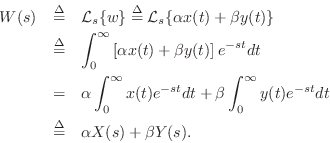
Thus, linearity of the Laplace transform follows immediately from the linearity of integration.
Differentiation
The differentiation theorem for Laplace transforms states that
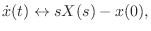
 , and is any
differentiable function that approaches zero as goes to infinity.
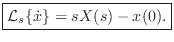
In operator notation,
, and is any
differentiable function that approaches zero as goes to infinity.
In operator notation,
Proof:
This follows immediately from integration by parts:
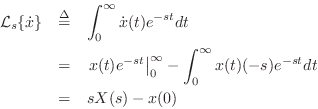
since
 by assumption.
Corollary: Integration Theorem
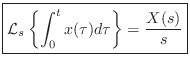
Thus, successive time derivatives correspond to successively higher
powers of , and successive integrals with respect to time
correspond to successively higher powers of  .
.
Laplace Analysis of Linear Systems
The differentiation theorem can be used to convert differential equations into algebraic equations, which are easier to solve. We will now show this by means of two examples.
Moving Mass
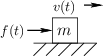
Figure D.1 depicts a free mass driven by an external force along
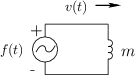
an ideal frictionless surface in one dimension. Figure D.2
shows the electrical equivalent circuit for this scenario in
which the external force is represented by a voltage source emitting
 volts, and the mass is modeled by an inductor
having the value
volts, and the mass is modeled by an inductor
having the value  Henrys.
From Newton's second law of motion `` '', we have

![\begin{eqnarray*}
F(s) &=& m\,{\cal L}_s\{{\ddot x}\}\\
&=& m\left[\,s {\cal L...
...right\}\\
&=& m\left[s^2\,X(s) - s\,x(0) - {\dot x}(0)\right].
\end{eqnarray*}](http://www.dsprelated.com/josimages_new/filters/img1738.png)
Thus, given
 Laplace transform of the driving force ,
 initial mass position, and
-
 initial mass velocity,
, the Laplace transform of the
mass position for all  . This Laplace transform can then be
inverted to obtain the mass position for all . This is
the general outline of how Laplace-transform analysis goes for
all linear, time-invariant (LTI) systems. For nonlinear and/or
time-varying systems, Laplace-transform analysis cannot, strictly
speaking, be used at all.
. This Laplace transform can then be
inverted to obtain the mass position for all . This is
the general outline of how Laplace-transform analysis goes for
all linear, time-invariant (LTI) systems. For nonlinear and/or
time-varying systems, Laplace-transform analysis cannot, strictly
speaking, be used at all.
If the applied external force is zero, then, by linearity of
the Laplace transform, so is  , and we readily obtain
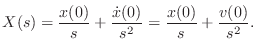 is the Laplace transform of the Heaviside unit-step function
![$\displaystyle u(t)\isdef \left\{\begin{array}{ll}
0, & t<0 \\ [5pt]
1, & t\ge 0 \\
\end{array}\right.,
$](http://www.dsprelated.com/josimages_new/filters/img1745.png) is given for all time by
is given for all time by

 and zero
initial velocity
and zero
initial velocity  results in
  for all ; that
is, the mass ``just sits there''.D.3 Similarly, any initial velocity
for all ; that
is, the mass ``just sits there''.D.3 Similarly, any initial velocity  is integrated with
respect to time, meaning that the mass moves forever at the initial
velocity.
is integrated with
respect to time, meaning that the mass moves forever at the initial
velocity.
To summarize, this simple example illustrated use the Laplace transform to solve for the motion of a simple physical system (an ideal mass) in response to initial conditions (no external driving forces). The system was described by a differential equation which was converted to an algebraic equation by the Laplace transform.
Mass-Spring Oscillator Analysis
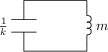
Consider now the mass-spring oscillator depicted physically in Fig.D.3, and in equivalent-circuit form in Fig.D.4.
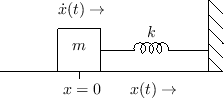 |
 sliding on a
frictionless surface, attached via an ideal spring
sliding on a
frictionless surface, attached via an ideal spring  .
.
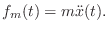
By Newton's second law of motion, the force  applied to a mass
equals its mass times its acceleration:
applied to a mass
equals its mass times its acceleration:
 applied to a spring is equal to the spring constant
  times the
displacement :
times the
displacement :

 . That is, the compression
force
. That is, the compression
force  applied by the mass to the spring is equal and opposite to
the accelerating force
applied by the mass to the spring is equal and opposite to
the accelerating force  exerted in the negative-
 direction by
the spring on the mass. In other words, the forces at the mass-spring
contact-point sum to zero:
direction by
the spring on the mass. In other words, the forces at the mass-spring
contact-point sum to zero:
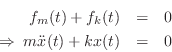
We have thus derived a second-order differential equation governing
the motion of the mass and spring. (Note that in
Fig.D.3 is both the position of the mass and compression
of the spring at time .)
Taking the Laplace transform of both sides of this differential equation gives
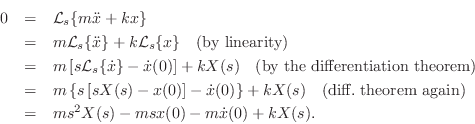
To simplify notation, denote the initial position and velocity by
and
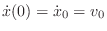 , respectively. Solving for
gives
, respectively. Solving for
gives
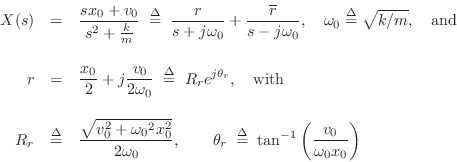
denoting the modulus and angle of the pole residue  , respectively.
From §D.1, the inverse Laplace transform of
, respectively.
From §D.1, the inverse Laplace transform of  is
is
 , where
  is the Heaviside unit step function at time 0.
Then by linearity, the solution for
the motion of the mass is
is the Heaviside unit step function at time 0.
Then by linearity, the solution for
the motion of the mass is
![\begin{eqnarray*}
x(t) &=& re^{-j{\omega_0}t} + \overline{r}e^{j{\omega_0}t}
= ...
...ga_0}t - \tan^{-1}\left(\frac{v_0}{{\omega_0}x_0}\right)\right].
\end{eqnarray*}](http://www.dsprelated.com/josimages_new/filters/img1771.png)
If the initial velocity is zero ( ), the above formula
reduces to
), the above formula
reduces to
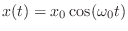 and the mass simply oscillates sinusoidally at frequency
 , starting from its initial position
  .
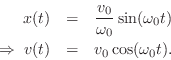
If instead the initial position is
.
If instead the initial position is  , we obtain
Next Section:
Analog Filters
Previous Section:
Allpass Filters












