







The Continuous-Time Impulse
The continuous-time impulse response was derived above as the inverse-Laplace transform of the transfer function. In this section, we look at how the impulse itself must be defined in the continuous-time case.
An impulse in continuous time may be loosely defined as any ``generalized function'' having ``zero width'' and unit area under it. A simple valid definition is
![$\displaystyle \delta(t) \isdef \lim_{\Delta \to 0} \left\{\begin{array}{ll} \fr...
...eq t\leq \Delta \\ [5pt] 0, & \hbox{otherwise}. \\ \end{array} \right. \protect$](http://www.dsprelated.com/josimages_new/filters/img1818.png)
More generally, an impulse can be defined as the limit of any pulse shape which maintains unit area and approaches zero width at time 0. As a result, the impulse under every definition has the so-called sifting property under integration,
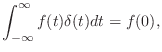
provided
 is continuous at
  . This is often taken as the
defining property of an impulse, allowing it to be defined in terms
of non-vanishing function limits such as
. This is often taken as the
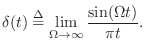
defining property of an impulse, allowing it to be defined in terms
of non-vanishing function limits such as
Next Section:
Poles and Zeros
Previous Section:
Impulse Response












