Existence of the Laplace Transform
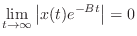
A function has a Laplace transform whenever it is of
exponential order. That is, there must be a real number
has a Laplace transform whenever it is of
exponential order. That is, there must be a real number  such that
 has a
Laplace transform for all finite values of
has a
Laplace transform for all finite values of  and
and  . Let's
look at this case more closely.
. Let's
look at this case more closely.
The Laplace transform of a causal, growing exponential function
![$\displaystyle x(t) = \left\{\begin{array}{ll}
A e^{\alpha t}, & t\geq 0 \\ [5pt]
0, & t<0 \\
\end{array}\right.,
$](http://www.dsprelated.com/josimages_new/filters/img1674.png)
![\begin{eqnarray*}
X(s) &\isdef & \int_0^\infty x(t) e^{-st}dt
= \int_0^\infty A...
...alpha \\ [5pt]
\infty, & \sigma<\alpha \\
\end{array} \right.
\end{eqnarray*}](http://www.dsprelated.com/josimages_new/filters/img1675.png)
Thus, the Laplace transform of an exponential
is
 , but this is defined only for
re
, but this is defined only for
re .
.
Next Section:
Analytic Continuation
Previous Section:
Allpass Problems