Inverting the Z Transform
The partial fraction expansion (PFE) provides a simple means for inverting the z transform of rational transfer functions. The PFE provides a sum of first-order terms of the form
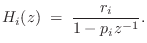

 is simply

 is a linear combination of
  geometric
sequences. The term ratio of the
geometric
sequences. The term ratio of the  th geometric sequence is
the th pole,
th geometric sequence is
the th pole,  , and the coefficient of the th
sequence is the th residue,
, and the coefficient of the th
sequence is the th residue,  .
.
In the improper case, discussed in the next section, we additionally obtain an FIR part in the z transform to be inverted:
![$\displaystyle F(z) \eqsp f_0 + f_1z^{-1}+ f_2z^{-2}+ \cdots + f_K z^{-K} \;\longleftrightarrow\;
[f_0,f_1,\ldots,f_K,0,0,\ldots].
$](http://www.dsprelated.com/josimages_new/filters/img725.png)
 ) is also easily
inverted by inspection.
) is also easily
inverted by inspection.
The case of repeated poles is addressed in §6.8.5 below.
Next Section:
FIR Part of a PFE
Previous Section:
PFE to Real, Second-Order Sections