







Partial Fraction Expansion
An important tool for inverting the z transform and converting among digital filter implementation structures is the partial fraction expansion (PFE). The term ``partial fraction expansion'' refers to the expansion of a rational transfer function into a sum of first and/or second-order terms. The case of first-order terms is the simplest and most fundamental:
where

and  . (The case
  is addressed in the next section.)
The denominator coefficients
is addressed in the next section.)
The denominator coefficients  are called the poles of the
transfer function, and each numerator
are called the poles of the
transfer function, and each numerator  is called the
residue of pole . Equation (6.7) is general only if the poles
are distinct. (Repeated poles are addressed in
§6.8.5 below.) Both the poles and their residues may be
complex. The poles may be found by factoring the polynomial
is called the
residue of pole . Equation (6.7) is general only if the poles
are distinct. (Repeated poles are addressed in
§6.8.5 below.) Both the poles and their residues may be
complex. The poles may be found by factoring the polynomial  into first-order terms,7.4e.g., using the roots function in matlab.
The residue corresponding to pole may be found
analytically as
into first-order terms,7.4e.g., using the roots function in matlab.
The residue corresponding to pole may be found
analytically as

when the poles
are distinct. The matlab function
residuez7.5 will find poles and residues
computationally, given the difference-equation (transfer-function)
coefficients.
Note that in Eq. (6.8), there is always a pole-zero cancellation at
 . That is, the term
 is always cancelled by an
identical term in the denominator of
is always cancelled by an
identical term in the denominator of  , which must exist because
has a pole at . The residue is simply the
coefficient of the one-pole term
, which must exist because
has a pole at . The residue is simply the
coefficient of the one-pole term
 in the partial
fraction expansion of at . The transfer function
is
in the partial
fraction expansion of at . The transfer function
is
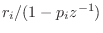 , in the limit, as
  .
.
Example
Consider the two-pole filter
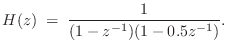
 and
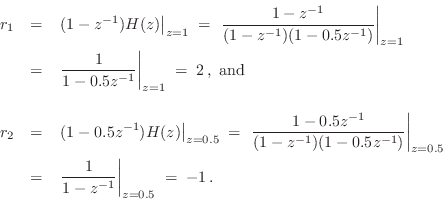
and  . The corresponding residues are then
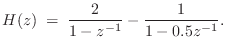
We thus conclude that

Complex Example
To illustrate an example involving complex poles, consider the filter
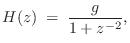
 can be any real or complex value. (When is real, the
filter as a whole is real also.) The poles are then
can be any real or complex value. (When is real, the
filter as a whole is real also.) The poles are then  and
and
 (or vice versa), and the factored form can be written as
 (6.8), the residues are found to be
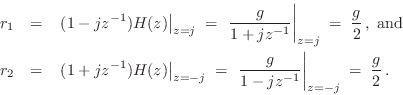
Thus,
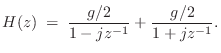
A more elaborate example of a partial fraction expansion into complex one-pole sections is given in §3.12.1.
PFE to Real, Second-Order Sections
When all coefficients of and  are real (implying that
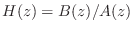 is the transfer function of
a real filter), it will
always happen that the complex one-pole filters will occur in
complex conjugate pairs. Let
is the transfer function of
a real filter), it will
always happen that the complex one-pole filters will occur in
complex conjugate pairs. Let  denote any one-pole
section in the PFE of Eq.(6.7). Then if
denote any one-pole
section in the PFE of Eq.(6.7). Then if  is complex and
describes a real filter, we will also find
is complex and
describes a real filter, we will also find
 somewhere among
the terms in the one-pole expansion. These two terms can be paired to
form a real second-order section as follows:
somewhere among
the terms in the one-pole expansion. These two terms can be paired to
form a real second-order section as follows:
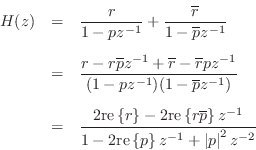
Expressing the pole in polar form as
 ,
and the residue as
,
and the residue as
 ,
the last expression above can be rewritten as
,
the last expression above can be rewritten as

Expanding a transfer function into a sum of second-order terms with
real coefficients gives us the filter coefficients for a parallel bank
of real second-order filter sections. (Of course, each real pole can
be implemented in its own real one-pole section in parallel with the
other sections.) In view of the foregoing, we may conclude that every
real filter with can be implemented as a parallel bank
of biquads.7.6 However, the full generality of a biquad
section (two poles and two zeros) is not needed because the PFE
requires only one zero per second-order term.
To see why we must stipulate in Eq.(6.7), consider the sum of two
first-order terms by direct calculation:
 |
(7.9) |
Notice that the numerator order, viewed as a polynomial in
 , is
one less than the denominator order. In the same way, it is easily
shown by mathematical induction that the sum of
, is
one less than the denominator order. In the same way, it is easily
shown by mathematical induction that the sum of  one-pole terms
can produce a numerator order of at most
one-pole terms
can produce a numerator order of at most  (while the denominator order is if there are no pole-zero
cancellations). Following terminology used for analog filters, we
call the case a strictly proper transfer
function.7.7 Thus, every strictly
proper transfer function (with distinct poles) can be implemented
using a parallel bank of two-pole, one-zero filter sections.
(while the denominator order is if there are no pole-zero
cancellations). Following terminology used for analog filters, we
call the case a strictly proper transfer
function.7.7 Thus, every strictly
proper transfer function (with distinct poles) can be implemented
using a parallel bank of two-pole, one-zero filter sections.
Inverting the Z Transform
The partial fraction expansion (PFE) provides a simple means for inverting the z transform of rational transfer functions. The PFE provides a sum of first-order terms of the form
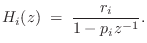
 is simply

 is a linear combination of geometric
sequences. The term ratio of the
is a linear combination of geometric
sequences. The term ratio of the  th geometric sequence is
the th pole, , and the coefficient of the th
sequence is the th residue, .
th geometric sequence is
the th pole, , and the coefficient of the th
sequence is the th residue, .
In the improper case, discussed in the next section, we additionally obtain an FIR part in the z transform to be inverted:
![$\displaystyle F(z) \eqsp f_0 + f_1z^{-1}+ f_2z^{-2}+ \cdots + f_K z^{-K} \;\longleftrightarrow\;
[f_0,f_1,\ldots,f_K,0,0,\ldots].
$](http://www.dsprelated.com/josimages_new/filters/img725.png) ) is also easily
inverted by inspection.
) is also easily
inverted by inspection.
The case of repeated poles is addressed in §6.8.5 below.
FIR Part of a PFE
When in Eq.(6.7), we may perform a step of long division
of  to produce an FIR part in parallel with a
strictly proper IIR part:
to produce an FIR part in parallel with a
strictly proper IIR part:
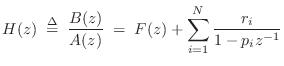
where

When , we define  . This type of decomposition is
computed by the residuez function (a matlab function for
computing a complete partial fraction expansion, as illustrated in
§6.8.8 below).
. This type of decomposition is
computed by the residuez function (a matlab function for
computing a complete partial fraction expansion, as illustrated in
§6.8.8 below).
An alternate FIR part is obtained by performing long division on the reversed polynomial coefficients to obtain
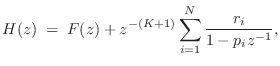
where
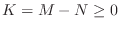 is again the order of the FIR part.
This type of decomposition is computed (as part of the PFE)
by residued, described in §J.6 and illustrated
numerically in §6.8.8 below.
is again the order of the FIR part.
This type of decomposition is computed (as part of the PFE)
by residued, described in §J.6 and illustrated
numerically in §6.8.8 below.
We may compare these two PFE alternatives as follows:
Let  denote ,
 , and
, and
 .
(I.e., we use a subscript to indicate polynomial order, and `
.
(I.e., we use a subscript to indicate polynomial order, and ` ' is
omitted for notational simplicity.) Then for
we have two cases:
' is
omitted for notational simplicity.) Then for
we have two cases:

In the first form, the
 coefficients are ``left
justified'' in the reconstructed numerator, while in the second form
they are ``right justified''. The second form is generally more
efficient for modeling purposes, since the numerator of the IIR
part (
coefficients are ``left
justified'' in the reconstructed numerator, while in the second form
they are ``right justified''. The second form is generally more
efficient for modeling purposes, since the numerator of the IIR
part (
 ) can be used to match additional
terms in the impulse response after the FIR part
) can be used to match additional
terms in the impulse response after the FIR part  has
``died out''.
has
``died out''.
In summary, an arbitrary digital filter transfer function with
distinct poles can always be expressed as a parallel combination
of complex one-pole filters, together with a parallel FIR part
when . When there is an FIR part, the strictly proper IIR
part may be delayed such that its impulse response begins where that
of the FIR part leaves off.
In artificial reverberation applications, the FIR part may correspond to the early reflections, while the IIR part provides the late reverb, which is typically dense, smooth, and exponentially decaying [86]. The predelay (``pre-delay'') control in some commercial reverberators is the amount of pure delay at the beginning of the reverberator's impulse response. Thus, neglecting the early reflections, the order of the FIR part can be viewed as the amount of predelay for the IIR part.
Example: The General Biquad PFE
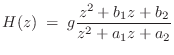
The general second-order case with  (the so-called
biquad section) can be written when
(the so-called
biquad section) can be written when  as
as

 and rewrite
as a ratio of polynomials in
and rewrite
as a ratio of polynomials in  :
:
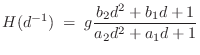

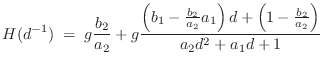
yielding
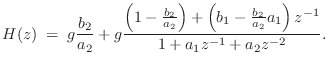
The delayed form of the partial fraction expansion is obtained by
leaving the coefficients in their original order. This corresponds
to writing as a ratio of polynomials in  :
:

giving

Numerical examples of partial fraction expansions are given in §6.8.8
below. Another worked example, in which the filter
 is converted to a set of parallel, second-order
sections is given in §3.12. See also §9.2 regarding
conversion to second-order sections in general, and §G.9.1 (especially
Eq.(G.22)) regarding
a state-space approach to partial fraction expansion.
is converted to a set of parallel, second-order
sections is given in §3.12. See also §9.2 regarding
conversion to second-order sections in general, and §G.9.1 (especially
Eq.(G.22)) regarding
a state-space approach to partial fraction expansion.
Alternate PFE Methods
Another method for finding the pole residues is to write down the general
form of the PFE, obtain a common denominator, expand the numerator
terms to obtain a single polynomial, and equate like powers of .
This gives a linear system of equations in unknowns ,
 .
.
Yet another method for finding residues is by means of Taylor series
expansions of the numerator and denominator about each
pole , using l'Hôpital's
rule..
Finally, one can alternatively construct a state space realization of a strictly proper transfer function (using, e.g., tf2ss in matlab) and then diagonalize it via a similarity transformation. (See Appendix G for an introduction to state-space models and diagonalizing them via similarity transformations.) The transfer function of the diagonalized state-space model is trivially obtained as a sum of one-pole terms--i.e., the PFE. In other words, diagonalizing a state-space filter realization implicitly performs a partial fraction expansion of the filter's transfer function. When the poles are distinct, the state-space model can be diagonalized; when there are repeated poles, it can be block-diagonalized instead, as discussed further in §G.10.
Repeated Poles
When poles are repeated, an interesting new phenomenon emerges. To see what's going on, let's consider two identical poles arranged in parallel and in series. In the parallel case, we have


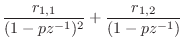 having multiplicity 2.
Dealing with Repeated Poles Analytically
A pole of multiplicity  has
residues associated with it. For example,
has
residues associated with it. For example,

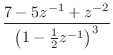

and the three residues associated with the pole
 are 1, 2, and 4.
Let  denote the
  th residue associated with the pole ,
 .
Successively differentiating
.
Successively differentiating
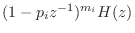
 times with
respect to and setting isolates the residue
times with
respect to and setting isolates the residue  :
:
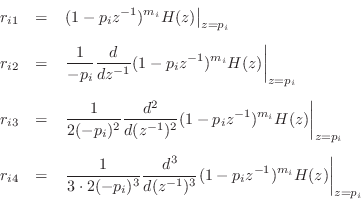
or

Example
For the example of Eq.(6.12), we obtain

Impulse Response of Repeated Poles
In the time domain, repeated poles give rise to polynomial amplitude envelopes on the decaying exponentials corresponding to the (stable) poles. For example, in the case of a single pole repeated twice, we have

Proof:
First note that

 |
 |
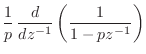 |
|
|
 |
||
|
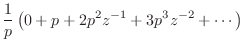 |
||
|
 |
||
|
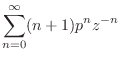 |
||
 |
 |
(7.13) |
Note that
 is a first-order polynomial in
  . Similarly, a pole
repeated three times corresponds to an impulse-response component that
is an exponential decay multiplied by a quadratic polynomial in
, and so on. As long as
. Similarly, a pole
repeated three times corresponds to an impulse-response component that
is an exponential decay multiplied by a quadratic polynomial in
, and so on. As long as  , the impulse response will
eventually decay to zero, because exponential decay always overtakes
polynomial growth in the limit as goes to infinity.
, the impulse response will
eventually decay to zero, because exponential decay always overtakes
polynomial growth in the limit as goes to infinity.
So What's Up with Repeated Poles?
In the previous section, we found that repeated poles give rise to polynomial amplitude-envelopes multiplying the exponential decay due to the pole. On the other hand, two different poles can only yield a convolution (or sum) of two different exponential decays, with no polynomial envelope allowed. This is true no matter how closely the poles come together; the polynomial envelope can occur only when the poles merge exactly. This might violate one's intuitive expectation of a continuous change when passing from two closely spaced poles to a repeated pole.
To study this phenomenon further, consider the convolution of two
one-pole impulse-responses
 and
and
 :
:

The finite limits on the summation result from the fact that both
 and
and  are causal. Recall the closed-form sum of a truncated
geometric series:
are causal. Recall the closed-form sum of a truncated
geometric series:
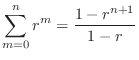 (6.14) yields

 and
and  . If
. If
 , then
  becomes proportional to
 for large , while if
 , it becomes
instead proportional to
, it becomes
instead proportional to  .
.
Going back to Eq.(6.14), we have
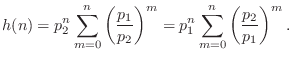 |
(7.15) |
Setting
 yields
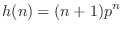 |
(7.16) |
which is the first-order polynomial amplitude-envelope case for a repeated pole. We can see that the transition from ``two convolved exponentials'' to ``single exponential with a polynomial amplitude envelope'' is perfectly continuous, as we would expect.
We also see that the polynomial amplitude-envelopes fundamentally
arise from iterated convolutions. This corresponds to the
repeated poles being arranged in series, rather than in
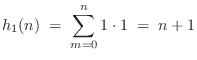
parallel. The simplest case is when the repeated pole is at  , in
which case its impulse response is a constant:
, in
which case its impulse response is a constant:
![$\displaystyle \frac{1}{1-z^{-1}} \eqsp
1 + z^{-1}+ z^{-2}+ \cdots \;\longleftrightarrow\; [1,1,1,\ldots]
$](http://www.dsprelated.com/josimages_new/filters/img795.png)

Alternate Stability Criterion
In §5.6 (page ![[*]](../icons/crossref.png) ), a filter was defined to
be stable if its impulse response decays to 0 in
magnitude as time goes to infinity. In §6.8.5, we saw that
the impulse response of every finite-order LTI filter can be expressed
as a possible FIR part (which is always stable) plus a linear
combination of terms of the form
), a filter was defined to
be stable if its impulse response decays to 0 in
magnitude as time goes to infinity. In §6.8.5, we saw that
the impulse response of every finite-order LTI filter can be expressed
as a possible FIR part (which is always stable) plus a linear
combination of terms of the form
 , where
  is some
finite-order polynomial in , and is the th pole of the
filter. In this form, it is clear that the impulse response always
decays to zero when each pole is strictly inside the unit circle of
the plane, i.e., when
is some
finite-order polynomial in , and is the th pole of the
filter. In this form, it is clear that the impulse response always
decays to zero when each pole is strictly inside the unit circle of
the plane, i.e., when  . Thus, having all poles strictly
inside the unit circle is a sufficient criterion for filter
stability. If the filter is observable (meaning that there are
no pole-zero cancellations in the transfer function from input to
output), then this is also a necessary criterion.
. Thus, having all poles strictly
inside the unit circle is a sufficient criterion for filter
stability. If the filter is observable (meaning that there are
no pole-zero cancellations in the transfer function from input to
output), then this is also a necessary criterion.
A transfer function with no pole-zero cancellations is said to be
irreducible. For example,
 is
irreducible, while
is
irreducible, while
 is reducible, since
there is the common factor of
is reducible, since
there is the common factor of
 in the numerator and
denominator. Using this terminology, we may state the following
stability criterion:
in the numerator and
denominator. Using this terminology, we may state the following
stability criterion:
This characterization of stability is pursued further in §8.4, and yet another stability test (most often used in practice) is given in §8.4.1.
Summary of the Partial Fraction Expansion
In summary, the partial fraction expansion can be used to expand any rational z transform

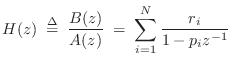 |
(7.17) |
for
, and
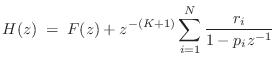
for
, where the term
 is optional, but often
preferred. For real filters, the complex one-pole terms may be paired
up to obtain second-order terms with real coefficients.
The PFE procedure occurs in two or three steps:
is optional, but often
preferred. For real filters, the complex one-pole terms may be paired
up to obtain second-order terms with real coefficients.
The PFE procedure occurs in two or three steps:
- When , perform a step of long division to obtain
an FIR part
 and a strictly proper IIR part
 .
.
- Find the poles ,
(roots of ).
- If the poles are distinct, find the residues ,
from
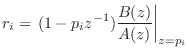
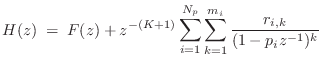
- If there are repeated poles, find the additional residues via
the method of §6.8.5, and the general form of the PFE is
where denotes the number of distinct poles, and
 denotes the multiplicity of the th pole.
In step 2, the poles are typically found by factoring the
denominator polynomial . This is a dangerous step numerically
which may fail when there are many poles, especially when many poles
are clustered close together in the plane.
The following matlab code illustrates factoring
 to
obtain the three roots,
to
obtain the three roots,
 ,
,  :
:
A = [1 0 0 -1];  % Filter denominator polynomial
poles = roots(A) % Filter poles
See Chapter 9 for additional discussion regarding digital filters implemented as parallel sections (especially §9.2.2).
Software for Partial Fraction Expansion
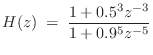
Figure 6.3 illustrates the use of residuez (§J.5) for performing a partial fraction expansion on the transfer function
B = [1 0 0 0.125]; A = [1 0 0 0 0 0.9^5]; [r,p,f] = residuez(B,A) % r = % 0.16571 % 0.22774 - 0.02016i % 0.22774 + 0.02016i % 0.18940 + 0.03262i % 0.18940 - 0.03262i % % p = % -0.90000 % -0.27812 - 0.85595i % -0.27812 + 0.85595i % 0.72812 - 0.52901i % 0.72812 + 0.52901i % % f = [](0x0) |
Example 2
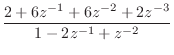
For the filter
![$\displaystyle (2+10z^{-1}) + z^{-2}\left[\frac{8}{1-z^{-1}} + \frac{16}{(1-z^{-1})^2}\right]
\protect$](http://www.dsprelated.com/josimages_new/filters/img819.png)
we obtain the output of residued (§J.6) shown in Fig.6.4. In contrast to residuez, residued delays the IIR part until after the FIR part. In contrast to this result, residuez returns r=[-24;16] and f=[10;2], corresponding to the PFE
 |
(7.22) |
in which the FIR and IIR parts have overlapping impulse responses.
See Sections J.5 and J.6 starting on page for
listings of residuez, residued and related
discussion.
B=[2 6 6 2]; A=[1 -2 1]; [r,p,f,m] = residued(B,A) % r = % 8 % 16 % % p = % 1 % 1 % % f = % 2 10 % % m = % 1 % 2 |
Polynomial Multiplication in Matlab
The matlab function conv (convolution) can be used to perform polynomial multiplication. For example:
B1 = [1 1];   % 1st row of Pascal's triangle
B2 = [1 2 1]; % 2nd row of Pascal's triangle
B3 = conv(B1,B2) % 3rd row
% B3 = 1  3  3  1
B4 = conv(B1,B3) % 4th row
% B4 = 1  4  6  4  1
% ...
The matlab conv(B1,B2) is identical to filter(B1,1,B2), except that conv returns the complete convolution of its two input vectors, while filter truncates the result to the length of the ``input signal'' B2.7.10 Thus, if B2 is zero-padded with length(B1)-1 zeros, it will return the complete convolution:
B1 = [1 2 3];
B2 = [4 5 6 7];
conv(B1,B2)
% ans = 4  13  28  34  32  21
filter(B1,1,B2)
% ans = 4  13  28  34
filter(B1,1,[B2,zeros(1,length(B1)-1)])
% ans = 4  13  28  34  32  21
Polynomial Division in Matlab
The matlab function deconv (deconvolution) can be used to perform polynomial long division in order to split an improper transfer function into its FIR and strictly proper parts:
B = [ 2 6 6 2]; % 2*(1+1/z)^3
A = [ 1 -2 1];  % (1-1/z)^2
[firpart,remainder] = deconv(B,A)
% firpart =
%   2  10
% remainder =
%    0    0   24   -8
Thus, this example finds that
is as written in Eq.(6.21).
This result can be checked by obtaining a common denominator in order
to recalculate the direct-form numerator:Bh = remainder + conv(firpart,A) % = 2 6 6 2
The operation deconv(B,A) can be implemented using filter in a manner analogous to the polynomial multiplication case (see §6.8.8 above):
firpart = filter(B,A,[1,zeros(1,length(B)-length(A))])
%       = 2 10
remainder = B - conv(firpart,A)
%         =  0 0 24 -8
That this must work can be seen by looking at Eq.
(6.21) and
noting that the impulse-response of the remainder (the strictly proper
part) does not begin until time  , so that the first two samples
of the impulse-response come only from the FIR part.
, so that the first two samples
of the impulse-response come only from the FIR part.
In summary, we may conveniently use convolution and deconvolution to perform polynomial multiplication and division, respectively, such as when converting transfer functions to various alternate forms.
When carrying out a partial fraction expansion on a transfer function having a numerator order which equals or exceeds the denominator order, a necessary preliminary step is to perform long division to obtain an FIR filter in parallel with a strictly proper transfer function. This section describes how an FIR part of any length can be extracted from an IIR filter, and this can be used for PFEs as well as for more advanced applications [].
Next Section:
Problems
Previous Section:
Series and Parallel Transfer Functions












