







A Sum of Sinusoids at the
Same Frequency is Another
Sinusoid at that Frequency
It is an important and fundamental fact that a sum of sinusoids at the same frequency, but different phase and amplitude, can always be expressed as a single sinusoid at that frequency with some resultant phase and amplitude. An important implication, for example, is that
That is, if a sinusoid is input to an LTI system, the output will be a sinusoid at the same frequency, but possibly altered in amplitude and phase. This follows because the output of every LTI system can be expressed as a linear combination of delayed copies of the input signal. In this section, we derive this important result for the general case of
 sinusoids at the same frequency.
Proof Using Trigonometry
We want to show it is always possible to solve

for
 and
and  , given
 for
for
 . For each
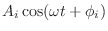
component sinusoid, we can write
. For each
component sinusoid, we can write
 |
 |
 |
|
|
![$\displaystyle \left[A_i\cos(\phi_i)\right]\cos(\omega t)
- \left[A_i\sin(\phi_i)\right]\sin(\omega t)$](http://www.dsprelated.com/josimages_new/filters/img1319.png) |
(A.3) |
Applying this expansion to Eq.
 (A.2) yields
![\begin{eqnarray*}
\left[A\cos(\phi)\right]\cos(\omega t)
&-&\left[A\sin(\phi)\ri...
...a t)
- \left[\sum_{i=1}^N A_i\sin(\phi_i)\right]\sin(\omega t).
\end{eqnarray*}](http://www.dsprelated.com/josimages_new/filters/img1320.png)
Equating coefficients gives

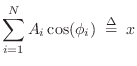

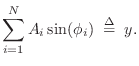
where
 and
and  are known. We now have two equations in two
unknowns which are readily solved by (1) squaring and adding both
sides to eliminate , and (2) forming a ratio of both sides of
Eq.(A.4) to eliminate . The results are
are known. We now have two equations in two
unknowns which are readily solved by (1) squaring and adding both
sides to eliminate , and (2) forming a ratio of both sides of
Eq.(A.4) to eliminate . The results are

which has a unique solution for any values of  and
and  .
.
Proof Using Complex Variables
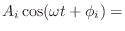
To show by means of phasor analysis that Eq.(A.2) always has a solution, we can express each component sinusoid as
 re
re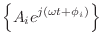
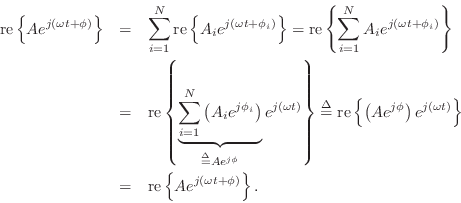
Thus, equality holds when we define
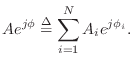
Since
 is just the polar representation of a complex
number, there is always some value of
is just the polar representation of a complex
number, there is always some value of  and
and
 such that
equals whatever complex number results on the
right-hand side of Eq.(A.5).
such that
equals whatever complex number results on the
right-hand side of Eq.(A.5).
As is often the case, we see that the use of Euler's identity and complex analysis gives a simplified algebraic proof which replaces a proof based on trigonometric identities.
Phasor Analysis: Factoring a Complex Sinusoid into Phasor Times Carrier
The heart of the preceding proof was the algebraic manipulation
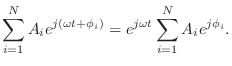
 ``factors out'' of the sum.
Inside the sum, each sinusoid is represented by a complex constant
``factors out'' of the sum.
Inside the sum, each sinusoid is represented by a complex constant
 , known as the phasor associated with that
sinusoid.
, known as the phasor associated with that
sinusoid.
For an arbitrary sinusoid having amplitude , phase , and
radian frequency  , we have
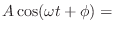 re
re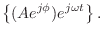 (which
specifies the carrier term) and its phasor
(which
specifies the carrier term) and its phasor
 ,
a complex constant. Phasor analysis is discussed further in
[84].
,
a complex constant. Phasor analysis is discussed further in
[84].
Next Section:
Elementary Filter Sections
Previous Section:
Complex and Trigonometric Identities












