Analytic Signals and Hilbert Transform Filters
A signal which has no negative-frequency components is called an
analytic signal.4.12 Therefore, in continuous time, every analytic signal
 can be represented as
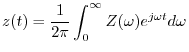
 is the complex coefficient (setting the amplitude and
phase) of the positive-frequency complex sinusoid
is the complex coefficient (setting the amplitude and
phase) of the positive-frequency complex sinusoid
 at
frequency
at
frequency  .
.
Any real sinusoid
 may be converted to a
positive-frequency complex sinusoid
may be converted to a
positive-frequency complex sinusoid
![$ A\exp[j(\omega t +
\phi)]$](http://www.dsprelated.com/josimages_new/mdft/img554.png) by simply generating a phase-quadrature component
by simply generating a phase-quadrature component
 to serve as the ``imaginary part'':

For more complicated signals which are expressible as a sum of many
sinusoids, a filter can be constructed which shifts each
sinusoidal component by a quarter cycle. This is called a
Hilbert transform filter. Let
 denote the output
at time
denote the output
at time  of the Hilbert-transform filter applied to the signal
  .
Ideally, this filter has magnitude
.
Ideally, this filter has magnitude  at all frequencies and
introduces a phase shift of
at all frequencies and
introduces a phase shift of  at each positive frequency and
 at each negative frequency. When a real signal
  and
its Hilbert transform
and
its Hilbert transform
 are used to form a new complex signal
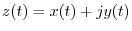 ,
the signal is the (complex) analytic signal corresponding to
the real signal . In other words, for any real signal , the
corresponding analytic signal
,
the signal is the (complex) analytic signal corresponding to
the real signal . In other words, for any real signal , the
corresponding analytic signal
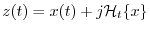 has the property
that all ``negative frequencies'' of have been ``filtered out.''
has the property
that all ``negative frequencies'' of have been ``filtered out.''
To see how this works, recall that these phase shifts can be impressed on a
complex sinusoid by multiplying it by
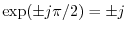 . Consider
the positive and negative frequency components at the particular frequency
. Consider
the positive and negative frequency components at the particular frequency
 :
:

Now let's apply a  degrees phase shift to the positive-frequency
component, and a
degrees phase shift to the positive-frequency
component, and a  degrees phase shift to the negative-frequency
component:
degrees phase shift to the negative-frequency
component:
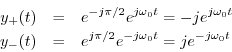
Adding them together gives

and sure enough, the negative frequency component is filtered out. (There is also a gain of 2 at positive frequencies.)
For a concrete example, let's start with the real sinusoid


The analytic signal is then

 , the
negative-frequency components of and
, the
negative-frequency components of and  cancel out,
leaving only the positive-frequency component. This happens for any
real signal , not just for sinusoids as in our example.
cancel out,
leaving only the positive-frequency component. This happens for any
real signal , not just for sinusoids as in our example.
![\includegraphics[width=2.8in]{eps/sineFD}](http://www.dsprelated.com/josimages_new/mdft/img576.png) |
 from the real sinusoid
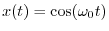 and the derived phase-quadrature sinusoid
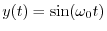 , viewed in the
  . c)
. c)  . d) Spectrum of
 .
.
Figure 4.16 illustrates what is going on in the frequency domain.
At the top is a graph of the spectrum of the sinusoid
 consisting of impulses at frequencies
 and
zero at all other frequencies (since
and
zero at all other frequencies (since
 ). Each impulse
amplitude is equal to
). Each impulse
amplitude is equal to  . (The amplitude of an impulse is its
algebraic area.) Similarly, since
. (The amplitude of an impulse is its
algebraic area.) Similarly, since
 , the spectrum of
 is an impulse of amplitude
  at
at
 and amplitude
  at
at
 .
Multiplying
.
Multiplying  by
by  results in
 which is shown in
the third plot, Fig.4.16c. Finally, adding together the first and
third plots, corresponding to
, we see that the
two positive-frequency impulses add in phase to give a unit
impulse (corresponding to
which is shown in
the third plot, Fig.4.16c. Finally, adding together the first and
third plots, corresponding to
, we see that the
two positive-frequency impulses add in phase to give a unit
impulse (corresponding to
 ), and at frequency
 , the two impulses, having opposite sign,
cancel in the sum, thus creating an analytic signal
, the two impulses, having opposite sign,
cancel in the sum, thus creating an analytic signal  ,
as shown in Fig.4.16d. This sequence of operations illustrates
how the negative-frequency component
,
as shown in Fig.4.16d. This sequence of operations illustrates
how the negative-frequency component
 gets
filtered out by summing
with
gets
filtered out by summing
with
 to produce the analytic signal
corresponding
to the real signal
.
to produce the analytic signal
corresponding
to the real signal
.
As a final example (and application), let
 ,
where
,
where  is a slowly varying amplitude envelope (slow compared
with ). This is an example of amplitude modulation
applied to a sinusoid at ``carrier frequency'' (which is
where you tune your AM radio). The Hilbert transform is very close to
is a slowly varying amplitude envelope (slow compared
with ). This is an example of amplitude modulation
applied to a sinusoid at ``carrier frequency'' (which is
where you tune your AM radio). The Hilbert transform is very close to
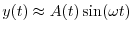 (if were constant, this would
be exact), and the analytic signal is
(if were constant, this would
be exact), and the analytic signal is
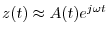 .
Note that AM demodulation4.14is now nothing more than the absolute value. I.e.,
.
Note that AM demodulation4.14is now nothing more than the absolute value. I.e.,
 . Due to this simplicity, Hilbert transforms are sometimes
used in making
amplitude envelope followers for narrowband signals (i.e., signals with all energy centered about a single ``carrier'' frequency).
AM demodulation is one application of a narrowband envelope follower.
. Due to this simplicity, Hilbert transforms are sometimes
used in making
amplitude envelope followers for narrowband signals (i.e., signals with all energy centered about a single ``carrier'' frequency).
AM demodulation is one application of a narrowband envelope follower.
Next Section:
Generalized Complex Sinusoids
Previous Section:
Sinusoidal Frequency Modulation (FM)