Autocorrelation
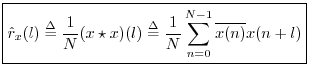
The cross-correlation of a signal with itself gives its autocorrelation:
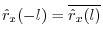
 is real, its autocorrelation is real and even
(symmetric about lag zero).
is real, its autocorrelation is real and even
(symmetric about lag zero).
The unbiased cross-correlation similarly reduces to an unbiased
autocorrelation when  :
:

The DFT of the true autocorrelation function
 is the (sampled)
power spectral density (PSD), or power spectrum, and may
be denoted
is the (sampled)
power spectral density (PSD), or power spectrum, and may
be denoted
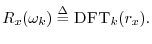
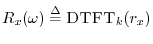 , where the DTFT is defined in Appendix B (it's just an
infinitely long DFT). The DFT of
, where the DTFT is defined in Appendix B (it's just an
infinitely long DFT). The DFT of
 thus provides a sample-based
estimate of the PSD:8.10
thus provides a sample-based
estimate of the PSD:8.10
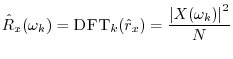
 a ``sampled sample power spectral
density''.
a ``sampled sample power spectral
density''.
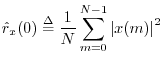
At lag zero, the autocorrelation function reduces to the average power (mean square) which we defined in §5.8:
Replacing ``correlation'' with ``covariance'' in the above definitions gives corresponding zero-mean versions. For example, we may define the sample circular cross-covariance as
![$\displaystyle \zbox {{\hat c}_{xy}(n)
\isdef \frac{1}{N}\sum_{m=0}^{N-1}\overline{[x(m)-\mu_x]} [y(m+n)-\mu_y].}
$](http://www.dsprelated.com/josimages_new/mdft/img1575.png)
 and
and  denote the means of and
  ,
respectively. We also have that
,
respectively. We also have that
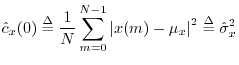
 equals the sample
variance of the signal :
equals the sample
variance of the signal :
Next Section:
Matched Filtering
Previous Section:
Unbiased Cross-Correlation