The DFT and its Inverse Restated
Let
 , denote an
  -sample complex sequence,
i.e.,
-sample complex sequence,
i.e.,
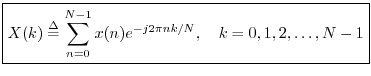
 . Then the spectrum of
  is defined by the
Discrete Fourier Transform (DFT):
is defined by the
Discrete Fourier Transform (DFT):

 , as this is most typical in the digital signal processing
literature. It is often said that the sampling frequency is
, as this is most typical in the digital signal processing
literature. It is often said that the sampling frequency is  .
In this case, a radian frequency
.
In this case, a radian frequency
 is in
units of ``radians per sample.'' Elsewhere in this book,
is in
units of ``radians per sample.'' Elsewhere in this book,  usually means ``radians per second.'' (Of course, there's no
difference when the sampling rate is really
usually means ``radians per second.'' (Of course, there's no
difference when the sampling rate is really  .) Another term we use
in connection with the convention is normalized
frequency: All normalized radian frequencies lie in the range
.) Another term we use
in connection with the convention is normalized
frequency: All normalized radian frequencies lie in the range
 , and all normalized frequencies in Hz lie in the range
 .7.1 Note that physical units
of seconds and Hertz can be reintroduced by the substitution
.7.1 Note that physical units
of seconds and Hertz can be reintroduced by the substitution

Notation and Terminology
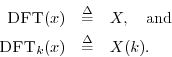
If  is the DFT of , we say that and form a transform
pair and write
is the DFT of , we say that and form a transform
pair and write



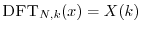
If we need to indicate the length of the DFT explicitly, we will write
 and
and
 .
As we've already seen, time-domain signals are consistently denoted
using lowercase symbols such as ``
.
As we've already seen, time-domain signals are consistently denoted
using lowercase symbols such as `` ,'' while frequency-domain
signals (spectra), are denoted in uppercase (``
,'' while frequency-domain
signals (spectra), are denoted in uppercase (``
 '').
'').
Modulo Indexing, Periodic Extension
The DFT sinusoids
 are all periodic
having periods which divide . That is,
are all periodic
having periods which divide . That is,
 for any
integer
for any
integer  . Since a length signal can be expressed as a linear
combination of the DFT sinusoids in the time domain,
. Since a length signal can be expressed as a linear
combination of the DFT sinusoids in the time domain,
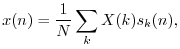 beyond the
range
beyond the
range ![$ [0,N-1]$](http://www.dsprelated.com/josimages_new/mdft/img1128.png) is periodic extension, i.e.,
is periodic extension, i.e.,
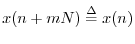 for every integer .
Moreover, the DFT also repeats naturally every samples, since

 . (The DFT sinusoids behave identically as functions of
  and
and
 .) Accordingly, for purposes of DFT studies, we may define all
signals in
.) Accordingly, for purposes of DFT studies, we may define all
signals in  as being single periods from an infinitely long periodic
signal with period samples:
as being single periods from an infinitely long periodic
signal with period samples:
Definition (Periodic Extension): For any signal
, we define
 .
.
As a result of this convention, all indexing of signals and
spectra7.2 can be interpreted modulo , and we may write
 to emphasize this. Formally, ``
 '' is defined as
 with chosen to give in the range .
As an example, when indexing a spectrum , we have that 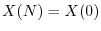 which can be interpreted physically as saying that the sampling rate
is the same frequency as dc for discrete time signals. Periodic
extension in the time domain implies that the signal input to the DFT
is mathematically treated as being samples of one period of a
periodic signal, with the period being exactly
which can be interpreted physically as saying that the sampling rate
is the same frequency as dc for discrete time signals. Periodic
extension in the time domain implies that the signal input to the DFT
is mathematically treated as being samples of one period of a
periodic signal, with the period being exactly  seconds (
samples). The corresponding assumption in the frequency domain is
that the spectrum is exactly zero between frequency samples
. It is also possible to adopt the point of view that the
time-domain signal consists of samples preceded and
followed by zeros. In that case, the spectrum would be
nonzero between spectral samples , and the spectrum
between samples would be reconstructed by means of bandlimited
interpolation [72].
seconds (
samples). The corresponding assumption in the frequency domain is
that the spectrum is exactly zero between frequency samples
. It is also possible to adopt the point of view that the
time-domain signal consists of samples preceded and
followed by zeros. In that case, the spectrum would be
nonzero between spectral samples , and the spectrum
between samples would be reconstructed by means of bandlimited
interpolation [72].
Next Section:
Signal Operators
Previous Section:
DFT Problems