FFT of a Zero-Padded Sinusoid
Looking back at Fig.8.2c, we see there are no negative dB values. Could this be right? Could the spectral magnitude at all frequencies be 1 or greater? The answer is no. To better see the true spectrum, let's use zero padding in the time domain (§7.2.7) to give ideal interpolation (§7.4.12) in the frequency domain:
zpf = 8;            % zero-padding factor
x = [cos(2*pi*n*f*T),zeros(1,(zpf-1)*N)]; % zero-padded
X = fft(x);         % interpolated spectrum
magX = abs(X);      % magnitude spectrum
...                 % waveform plot as before
nfft = zpf*N;       % FFT size = new frequency grid size
fni = [0:1.0/nfft:1-1.0/nfft]; % normalized freq axis
subplot(3,1,2);
% with interpolation, we can use solid lines '-':
plot(fni,magX,'-k'); grid on;
...
spec = 20*log10(magX); % spectral magnitude in dB
% clip below at -40 dB:
spec = max(spec,-40*ones(1,length(spec)));
...                 % plot as before
![\includegraphics[width=\twidth]{eps/example3}](http://www.dsprelated.com/josimages_new/mdft/img1512.png) |
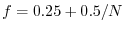 cycles/sample. a) Time waveform. b) Magnitude
Figure 8.4 shows the zero-padded data (top) and corresponding
interpolated spectrum on linear and dB scales (middle and bottom,
respectively). We now see that the spectrum has a regular
sidelobe structure. On the dB scale in Fig.8.4c,
negative values are now visible. In fact, it was desirable to
clip them at  dB to prevent deep nulls from dominating the
display by pushing the negative vertical axis limit to
dB to prevent deep nulls from dominating the
display by pushing the negative vertical axis limit to  dB or
more, as in Fig.8.1c (page
dB or
more, as in Fig.8.1c (page ![[*]](../icons/crossref.png) ). This
example shows the importance of using zero padding to interpolate
spectral displays so that the untrained eye will ``fill in'' properly
between the spectral samples.
). This
example shows the importance of using zero padding to interpolate
spectral displays so that the untrained eye will ``fill in'' properly
between the spectral samples.
Next Section:
Use of a Blackman Window
Previous Section:
FFT of a Not-So-Simple Sinusoid