







Differentiator Filter Bank
Since, in the time domain, a Taylor series expansion of
 about time
  gives
gives
![\begin{eqnarray*}
x(n-\Delta)
&=& x(n) -\Delta\, x^\prime(n)
+ \frac{\Delta^2...
...D^2(z) + \cdots
+ \frac{(-\Delta)^k}{k!}D^k(z) + \cdots \right]
\end{eqnarray*}](http://www.dsprelated.com/josimages_new/pasp/img1101.png)
where  denotes the transfer function of the ideal differentiator,
we see that the
denotes the transfer function of the ideal differentiator,
we see that the  th filter in Eq.
 (4.10) should approach
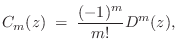
in the limit, as the number of terms
 goes to infinity.
In other terms, the coefficient
goes to infinity.
In other terms, the coefficient  of
of  in the polynomial
expansion Eq.(4.10) must become proportional to the
th-order differentiator as the polynomial order increases.
For any finite
in the polynomial
expansion Eq.(4.10) must become proportional to the
th-order differentiator as the polynomial order increases.
For any finite  , we expect to be close to some scaling of
the th-order differentiator. Choosing as in Eq.(4.12)
for finite gives a truncated Taylor series approximation of
the ideal delay operator in the time domain [184, p. 1748].
Such an approximation is ``maximally smooth'' in the time domain, in
the sense that the first derivatives of the interpolation error
are zero at
, we expect to be close to some scaling of
the th-order differentiator. Choosing as in Eq.(4.12)
for finite gives a truncated Taylor series approximation of
the ideal delay operator in the time domain [184, p. 1748].
Such an approximation is ``maximally smooth'' in the time domain, in
the sense that the first derivatives of the interpolation error
are zero at  .5.6 The
approximation error in the time domain can be said to be
maximally flat.
.5.6 The
approximation error in the time domain can be said to be
maximally flat.
Farrow structures such as Fig.4.19 may be used to implement any
one-parameter filter variation in terms of several constant
filters. The same basic idea of polynomial expansion has been applied
also to time-varying filters (
 ).
).
Next Section:
Choice of Table Size and Word Lengths
Previous Section:
Farrow Structure Coefficients












