Early Reflections
The ``early reflections'' portion of the impulse response of a reverberant environment is often taken to be the first 100ms or so [314]. However, for greater accuracy, it should be extended to the time at which the reverberation reaches its asymptotic statistical behavior.4.5
Since the early reflections are relatively sparse and span a relatively short time, they are often implemented using tapped delay lines (TDL).4.6
If the computation is affordable, it is best to spatialize the early reflections [248] so that they come from the right directions in 3D space. It is known [61] that the early reflections have a strong influence on spatial impression, i.e., the listener's perception of the listening-space shape.
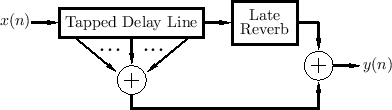
Figure 3.3 shows a general schematic of a reverberator with separate implementations of early and late reverberation. The taps on the TDL may include lowpass filtering for simulation of air absorption.
While the late reverb logically begins when the early reflections end, as implemented in Fig.3.3, it may be more cost-effective in practice to feed the ``late reverb'' unit from an earlier tap (or set of taps) from the TDL, thus overlapping them somewhat. This can help when the late reverberator needs time to build up to full density.
It is often the case that early reflections can be worked into the late-reverberation simulation. For example, usually there are long delay lines in which the input signal can be summed at various points, thereby implementing a transposed tapped delay line (see §2.5.2).
Good concert halls are observed to have to have stereo-recorded impulse responses that quickly ``lateralize'', with a smooth decay and overall duration of approximately 1.9 seconds [48].
Next Section:
Late Reverberation Approximations
Previous Section:
Perceptual Aspects of Reverberation