







Frequency-Dependent Air-Absorption Filtering
More generally, frequency-dependent air absorption can be modeled using the substitution
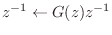
 denotes the filtering per sample in the
propagation medium. Since air absorption cannot amplify a wave at any
frequency, we have
denotes the filtering per sample in the
propagation medium. Since air absorption cannot amplify a wave at any
frequency, we have
 . A lossy delay line for
plane-wave simulation is thus described by
. A lossy delay line for
plane-wave simulation is thus described by
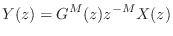
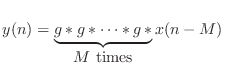
 ' denotes convolution, and
  is
the impulse response of the per-sample loss filter . The effect
of on the poles of the system is discussed in §3.7.4.
is
the impulse response of the per-sample loss filter . The effect
of on the poles of the system is discussed in §3.7.4.
For spherical waves, the loss due to spherical spreading is of the form
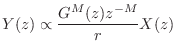
 is the distance from
  to
to  . We see that the spherical
spreading loss factor is ``hyperbolic'' in the propagation distance
, while air absorption is exponential in .
. We see that the spherical
spreading loss factor is ``hyperbolic'' in the propagation distance
, while air absorption is exponential in .
Next Section:
Dispersive Traveling Waves
Previous Section:
Exponentially Decaying Traveling Waves












