







Achieving Desired Reverberation Times
A lossless prototype reverberator, as in Fig.3.10 when  ,
has all of its poles on the unit circle in the
,
has all of its poles on the unit circle in the  plane, and its
reverberation time is infinity. To set the reverberation time to a
desired value, we need to move the poles slightly inside the unit
circle. Furthermore, due to air absorption
(§2.3,§B.7.15), we want the high-frequency
poles to be more damped than the low-frequency poles
[314]. As discussed in §2.3, this type
of transformation can be obtained using the substitution
plane, and its
reverberation time is infinity. To set the reverberation time to a
desired value, we need to move the poles slightly inside the unit
circle. Furthermore, due to air absorption
(§2.3,§B.7.15), we want the high-frequency
poles to be more damped than the low-frequency poles
[314]. As discussed in §2.3, this type
of transformation can be obtained using the substitution
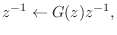
where
 denotes the filtering per sample in the
propagation medium (a lowpass filter with gain not exceeding 1 at all
frequencies).4.14Thus, to set the FDN reverberation time to
denotes the filtering per sample in the
propagation medium (a lowpass filter with gain not exceeding 1 at all
frequencies).4.14Thus, to set the FDN reverberation time to
 at frequency
  ,
we want propagation through
,
we want propagation through  samples to result in attenuation
by
samples to result in attenuation
by  dB, i.e.,
![$\displaystyle \left[G(e^{j\omega T})\right]^{n_{60}(\omega)} \eqsp 0.001. \protect$](http://www.dsprelated.com/josimages_new/pasp/img818.png)
Solving for
 , the propagation attenuation per-sample, gives




The last form comes from
 ln
ln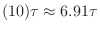 , where
 denotes the time constant of decay (time to decay by
  )
[451], i.e.,
)
[451], i.e.,
 ln
ln
Series expanding
 and assuming
 samples (
 seconds) provides the practically useful approximation

Conformal Map Interpretation of Damping Substitution
The relation
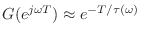 [Eq.
[Eq. (3.7)] can
be written down directly from
(3.7)] can
be written down directly from
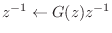 [Eq.(3.5)] by interpreting Eq.(3.5) as an approximate
conformal map [326] which takes each pole
[Eq.(3.5)] by interpreting Eq.(3.5) as an approximate
conformal map [326] which takes each pole
 ,
say, from the unit circle to the point
,
say, from the unit circle to the point
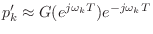 .
Thus, the new pole radius is approximately
.
Thus, the new pole radius is approximately
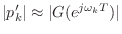 ,
where the approximation is valid when is approximately constant
between the new pole location and the unit circle. To see this,
consider the partial fraction expansion [449] of a proper
,
where the approximation is valid when is approximately constant
between the new pole location and the unit circle. To see this,
consider the partial fraction expansion [449] of a proper
 th-order lossless transfer function
  mapped to
![$ H'(z)\isdeftext H[z/G(z)]$](http://www.dsprelated.com/josimages_new/pasp/img837.png) :
:
![$\displaystyle H'(z)
= \sum_{k=1}^N \frac{r_k}{1-p_kG(z)z^{-1}}
= \sum_{k=1}^N r_k\left[1+p_kG(z)z^{-1}+p_k^2G^2(z)z^{-2}+\cdots\right],
$](http://www.dsprelated.com/josimages_new/pasp/img838.png)
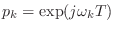 denotes the
  th original pole on the
unit circle. Then
th original pole on the
unit circle. Then  has a pole at
 , which must
be solved iteratively for
, which must
be solved iteratively for  , in general, since can be a
complicated function of . However, if
, in general, since can be a
complicated function of . However, if
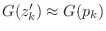 ,
which is typically true when damping digital waveguides for music
applications, then
,
which is typically true when damping digital waveguides for music
applications, then
![$ z'_k\approx p_kG(p_k)=G[\exp(j\omega_k
T)]\exp(j\omega_k T)$](http://www.dsprelated.com/josimages_new/pasp/img844.png) . In other words, we can think of the pole
. In other words, we can think of the pole  as moving from
 to near
![$ G[\exp(j\omega_k
T)]\exp(j\omega_k T)$](http://www.dsprelated.com/josimages_new/pasp/img847.png) , provided it doesn't move too far compared with
the near-constant behavior of . Another way to say it is that
we need to be approximately the same at the new pole location
and its initial location on the unit circle in the lossless prototype.
, provided it doesn't move too far compared with
the near-constant behavior of . Another way to say it is that
we need to be approximately the same at the new pole location
and its initial location on the unit circle in the lossless prototype.
Happily, while we may not know precisely where our poles have moved as
a result of introducing the per-sample damping filter , the
relation
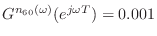 [Eq.(3.6)] remains
exact at every frequency by construction, as it is based only on the
physical interpretation of each unit delay as a propagation delay for
a plane wave across one sampling interval
[Eq.(3.6)] remains
exact at every frequency by construction, as it is based only on the
physical interpretation of each unit delay as a propagation delay for
a plane wave across one sampling interval  , during which
(zero-phase) filtering by is assumed (§2.3). More
generally, we can design minimum-phase filters for which
, during which
(zero-phase) filtering by is assumed (§2.3). More
generally, we can design minimum-phase filters for which
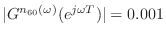 , and neglect the resulting
phase dispersion.
, and neglect the resulting
phase dispersion.
In summary, we see that replacing  by
by
 everywhere in the
FDN lossless prototype (or any lossless LTI system for that matter)
serves to move its poles away from the unit circle in the plane
onto some contour inside the unit circle that provides the desired
decay time at each frequency.
everywhere in the
FDN lossless prototype (or any lossless LTI system for that matter)
serves to move its poles away from the unit circle in the plane
onto some contour inside the unit circle that provides the desired
decay time at each frequency.
A general design guideline for artificial reverberation applications
[217] is that all pole radii in the
reverberator should vary smoothly with frequency. This translates
to having a smooth frequency response. To see why this
is desired, consider momentarily the frequency-independent case in
which we desire the same reverberation time at all frequencies
(Fig.3.10 with real  , as drawn). In this case, it is
ideal for all of the poles to have this decay time. Otherwise, the
late decay of the impulse response will be dominated by the poles
having the largest magnitude, and it will be ``thinner'' than it was
at the beginning of the response when all poles were contributing to
the output. Only when all poles have the same magnitude will the late
response maintain the same modal density throughout the decay.
, as drawn). In this case, it is
ideal for all of the poles to have this decay time. Otherwise, the
late decay of the impulse response will be dominated by the poles
having the largest magnitude, and it will be ``thinner'' than it was
at the beginning of the response when all poles were contributing to
the output. Only when all poles have the same magnitude will the late
response maintain the same modal density throughout the decay.
Damping Filters for Reverberation Delay Lines
In an FDN, such as the one shown in Fig.3.10, delays appear
in long delay-line chains  . Therefore, the filter needed at
the output (or input) of the
. Therefore, the filter needed at
the output (or input) of the  th delay line is
 (replace
 by
in Fig.3.10).4.15 However, because
by
in Fig.3.10).4.15 However, because
 is so close to
  in magnitude, and because it varies so weakly
across the frequency axis, we can design a much lower-order filter
in magnitude, and because it varies so weakly
across the frequency axis, we can design a much lower-order filter
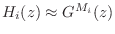 that provides the desired attenuation
versus frequency to within psychoacoustic resolution. In fact,
perfectly nice reverberators can be designed in which
that provides the desired attenuation
versus frequency to within psychoacoustic resolution. In fact,
perfectly nice reverberators can be designed in which  is
merely first order for each
[314,217].
is
merely first order for each
[314,217].
Next Section:
Delay-Line Damping Filter Design
Previous Section:
Choice of Delay Lengths












