Sign in

username:

password:


Not a member?

Search Online Books


Search tips

Free Online Books

Sponsor

Industry's highest performing at the lowest power DSPs now as low as $5.00*
Start development today!
*volume pricing for 10ku

Chapters

See Also

Embedded SystemsFPGAElectronics
Chapter Contents:

Search Physical Audio Signal Processing


Book Index | Global Index


Would you like to be notified by email when Julius Orion Smith III publishes a new entry into his blog?


General Causal FIR Filters

The most general case--a TDL having a tap after every delay element--is the general causal Finite Impulse Response (FIR) filter, shown in Fig.2.22. It is restricted to be causal because the output $ y(n)$ may not depend on ``future'' inputs $ x(n+1)$, $ x(n+2)$, etc. The FIR filter is also called a transversal filter. FIR filters are described in greater detail in [449].
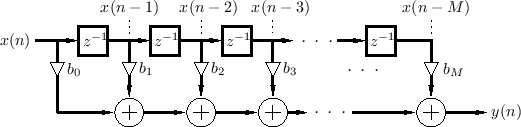
Figure 2.22: The general, causal, finite-impulse-response (FIR) digital filter.
\includegraphics{eps/fir}

The difference equation for the $ M$th-order FIR filter in Fig.2.22 is, by inspection,

$\displaystyle y(n) = b_0 x(n) + b_1 x(n-1) + b_2 x(n-2) + b_3 x(n-3) + \cdots + b_M x(n-M)
$

and the transfer function is

$\displaystyle H(z) = b_0 + b_1 z^{-1} + b_2 z^{-2} + b_3 z^{-3} + \cdots + b_M z^{-M}
= \sum_{m=0}^M b_m z^{-m} \isdef B(z).
$

The STK class for implementing arbitrary direct-form FIR filters is called Fir. (There is also a class for IIR filters named Iir.) In Matlab and Octave, the built-in function filter is normally used.


Previous: TDL for Parallel Processing

Next: Comb Filters

Order a Hardcopy of Physical Audio Signal Processing


About the Author: Julius Orion Smith III
Julius Smith's background is in electrical engineering (BS Rice 1975, PhD Stanford 1983). He is presently Professor of Music and Associate Professor (by courtesy) of Electrical Engineering at Stanford's Center for Computer Research in Music and Acoustics (CCRMA), teaching courses and pursuing research related to signal processing applied to music and audio systems. See http://ccrma.stanford.edu/~jos/ for details.


Comments


No comments yet for this page


Add a Comment
You need to login before you can post a comment (best way to prevent spam). ( Not a member? )