







General Conditions for Losslessness
The scattering matrices for lossless physical waveguide junctions give an apparently unexplored class of lossless FDN prototypes. However, this is just a subset of all possible lossless feedback matrices. We are therefore interested in the most general conditions for losslessness of an FDN feedback matrix. The results below are adapted from [463,385].
Consider the general case in which
 is allowed to be any
scattering matrix, i.e., it is associated with a
not-necessarily-physical junction of
is allowed to be any
scattering matrix, i.e., it is associated with a
not-necessarily-physical junction of  physical waveguides.
Following the definition of losslessness in classical network theory,
we may say that a waveguide scattering matrix
is said to be
lossless if the total complex power
[35] at the junction is scattering invariant, i.e.,
physical waveguides.
Following the definition of losslessness in classical network theory,
we may say that a waveguide scattering matrix
is said to be
lossless if the total complex power
[35] at the junction is scattering invariant, i.e.,


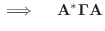

where
 is any Hermitian, positive-definite matrix (which has an
interpretation as a generalized junction admittance). The form
is any Hermitian, positive-definite matrix (which has an
interpretation as a generalized junction admittance). The form
 is by definition the square of the elliptic norm of
  induced
by
, or
induced
by
, or
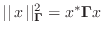 . Setting
 , we
obtain that
must be unitary. This is the case commonly used in
current FDN practice.
, we
obtain that
must be unitary. This is the case commonly used in
current FDN practice.
The following theorem gives a general characterization of lossless scattering:
Theorem: A scattering matrix (FDN feedback matrix)
is
lossless if and only if its eigenvalues lie on the unit circle and its
eigenvectors are linearly independent.
Proof: Since
is positive definite, it can be factored (by
the Cholesky factorization) into the form
 , where
 is an upper triangular matrix, and
 denotes the Hermitian
transpose of
, i.e.,
denotes the Hermitian
transpose of
, i.e.,
 . Since
is
positive definite,
is nonsingular and can be used as a
similarity transformation matrix. Applying the Cholesky decomposition
in Eq.
. Since
is
positive definite,
is nonsingular and can be used as a
similarity transformation matrix. Applying the Cholesky decomposition
in Eq. (C.125) yields
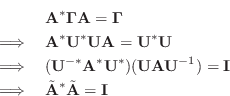
where
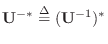 , and
, and
 using
using
 as the similarity transform matrix.
Since
as the similarity transform matrix.
Since
 is unitary, its eigenvalues have modulus 1. Hence, the
eigenvalues of every lossless scattering matrix lie on the unit circle
in the
is unitary, its eigenvalues have modulus 1. Hence, the
eigenvalues of every lossless scattering matrix lie on the unit circle
in the  plane. It readily follows from similarity to
that
admits linearly independent eigenvectors. In fact,
is a normal matrix (
plane. It readily follows from similarity to
that
admits linearly independent eigenvectors. In fact,
is a normal matrix (
 ), since every
unitary matrix is normal, and normal matrices admit a basis of
linearly independent eigenvectors [346].
), since every
unitary matrix is normal, and normal matrices admit a basis of
linearly independent eigenvectors [346].
Conversely, assume
 for each eigenvalue of
, and
that there exists a matrix
for each eigenvalue of
, and
that there exists a matrix
 of linearly independent
eigenvectors of
. The matrix
diagonalizes
to give
of linearly independent
eigenvectors of
. The matrix
diagonalizes
to give
 , where
 diag
diag . Taking the Hermitian transform of
this equation gives
. Taking the Hermitian transform of
this equation gives
 . Multiplying, we
obtain
. Multiplying, we
obtain
 . Thus, (C.125) is satisfied for
 which is Hermitian and positive
definite.
which is Hermitian and positive
definite. 
Thus, lossless scattering matrices may be fully parametrized as
 , where
 is any unit-modulus diagonal
matrix, and
is any invertible matrix. In the real case, we
have
diag
is any unit-modulus diagonal
matrix, and
is any invertible matrix. In the real case, we
have
diag and
and
 .
.
Note that not all lossless scattering matrices have a simple
physical interpretation as a scattering matrix for an
intersection of lossless reflectively terminated waveguides. In
addition to these cases (generated by all non-negative branch
impedances), there are additional cases corresponding to sign flips
and branch permutations at the junction. In terms of classical
network theory [35], such additional cases can be seen as
arising from the use of ``gyrators'' and/or ``circulators'' at the
scattering junction
[433]).
Next Section:
Gyrators
Previous Section:
Normalized Scattering












