







Nonlinear Spring Model
In the musical acoustics literature, the piano hammer is classically
modeled as a nonlinear spring
[493,63,178,76,60,486,164].10.14Specifically, the piano-hammer damping in Fig.9.22 is
typically approximated by  , and the spring
  is
nonlinear and memoryless according to a simple power
law:
is
nonlinear and memoryless according to a simple power
law:

 for a linear spring, and generally
  for pianos. A
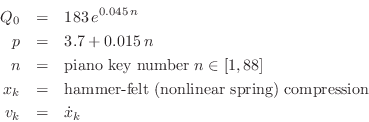
fairly complete model across the piano keyboard (based on acoustic
piano measurements) is as follows [487]:
for pianos. A
fairly complete model across the piano keyboard (based on acoustic
piano measurements) is as follows [487]:
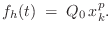
The upward force applied to the string by the hammer is therefore
 |
(10.20) |
This force is balanced at all times by the downward string force (string tension times slope difference), exactly as analyzed in §9.3.1 above.
Next Section:
Including Hysteresis
Previous Section:
Displacement-Wave Simulation












