







Ideal String Struck by a Mass
In §6.6, the ideal struck string was modeled as a simple initial velocity distribution along the string, corresponding to an instantaneous transfer of linear momentum from the striking hammer into the transverse motion of a string segment at time zero. (See Fig.6.10 for a diagram of the initial traveling velocity waves.) In that model, we neglected any effect of the striking hammer after time zero, as if it had bounced away at time 0 due to a so-called elastic collision. In this section, we consider the more realistic case of an inelastic collision, i.e., where the mass hits the string and remains in contact until something, such as a wave, or gravity, causes the mass and string to separate.
For simplicity, let the string length be infinity, and denote its wave
impedance by  . Denote the colliding mass by
  and its speed
prior to collision by
and its speed
prior to collision by  . It will turn out in this analysis that
we may approximate the size of the mass by zero (a so-called
point mass). Finally, we neglect the effects of gravity and
drag by the surrounding air. When the mass collides with the string,
our model must switch from two separate models (mass-in-flight and
ideal string), to that of two ideal strings joined by a mass at
. It will turn out in this analysis that
we may approximate the size of the mass by zero (a so-called
point mass). Finally, we neglect the effects of gravity and
drag by the surrounding air. When the mass collides with the string,
our model must switch from two separate models (mass-in-flight and
ideal string), to that of two ideal strings joined by a mass at
 , as depicted in Fig.9.12. The ``force-velocity
port'' connections of the mass and two semi-infinite string endpoints
are formally in series because they all move together; that is,
the mass velocity equals the velocity of each of the two string
endpoints connected to the mass (see §7.2 for a fuller
discussion of impedances and their parallel/series connection).
, as depicted in Fig.9.12. The ``force-velocity
port'' connections of the mass and two semi-infinite string endpoints
are formally in series because they all move together; that is,
the mass velocity equals the velocity of each of the two string
endpoints connected to the mass (see §7.2 for a fuller
discussion of impedances and their parallel/series connection).
![\includegraphics[width=\twidth]{eps/massstringphy}](http://www.dsprelated.com/josimages_new/pasp/img2032.png)
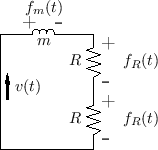
The equivalent circuit for the mass-string assembly after time zero is
shown in Fig.9.13. Note that the string wave impedance
appears twice, once for each string segment on the left and right.
Also note that there is a single common velocity  for the two
string endpoints and mass. LTI circuit elements in series can be
arranged in any order.
for the two
string endpoints and mass. LTI circuit elements in series can be
arranged in any order.
 |
From the equivalent circuit, it is easy to solve for the velocity .
Formally, this is accomplished by applying Kirchoff's Loop Rule, which
states that the sum of voltages (``forces'') around any series loop is zero:

All of the signs are `
 ' in this equation because the ``current''
(velocity ) flows into the `' sign of each element. These
reference directions indicated by `
' in this equation because the ``current''
(velocity ) flows into the `' sign of each element. These
reference directions indicated by ` ' on each element in
Fig.9.13 may be chosen arbitrarily, but it is convenient to
adopt the convention that flows into the `' sign for each
reaction force, and into the `
' on each element in
Fig.9.13 may be chosen arbitrarily, but it is convenient to
adopt the convention that flows into the `' sign for each
reaction force, and into the ` ' sign for each action
force (or driving force or voltage/current source,
etc.). With this convention, Kirchoff's Loop Rule effectively states
``the sum of all action forces equals the sum of all reaction
forces,'' where the forces are understood to act on a common point.
This is essentially Newton's third law of motion ``for every action
there is an equal and opposite reaction'' (§B.1). In our
mass-string example, all three forces are defined to be reaction
forces because there is no external driving force on the mass, and no
incoming waves from the string segments. External driving forces on
the mass-string junction will be formulated later below.10.8 We could equally well have defined
the mass inertial force as a driving force on the two string segments,
or the string segments could comprise a pair of driving forces for the
mass. Ultimately, any force polarities may be assigned and
consistently handled.
' sign for each action
force (or driving force or voltage/current source,
etc.). With this convention, Kirchoff's Loop Rule effectively states
``the sum of all action forces equals the sum of all reaction
forces,'' where the forces are understood to act on a common point.
This is essentially Newton's third law of motion ``for every action
there is an equal and opposite reaction'' (§B.1). In our
mass-string example, all three forces are defined to be reaction
forces because there is no external driving force on the mass, and no
incoming waves from the string segments. External driving forces on
the mass-string junction will be formulated later below.10.8 We could equally well have defined
the mass inertial force as a driving force on the two string segments,
or the string segments could comprise a pair of driving forces for the
mass. Ultimately, any force polarities may be assigned and
consistently handled.
Taking the Laplace transform10.9of Eq. (9.8) yields, by linearity,

where
 and
and  denote the Laplace transforms of
 and
and  , respectively. As discussed above, the
impedance relation for each string endpoint is given by
, respectively. As discussed above, the
impedance relation for each string endpoint is given by

 denotes the Laplace transform of .
For the mass, we have
![$\displaystyle f_m(t) = m\,a(t)\;=\; m\,\frac{d}{dt} v(t) \quad\longleftrightarrow\quad
F_m(s) = m\left[s\,V(s) - v_0\right],
$](http://www.dsprelated.com/josimages_new/pasp/img2043.png)
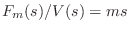 when the initial velocity is zero
(§7.1).
when the initial velocity is zero
(§7.1).
Substituting these relations into Eq.(9.9) yields

We see that the initial momentum
 of the mass effectively
provides an impulsive external driving force
of the mass effectively
provides an impulsive external driving force
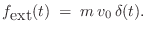 to the
mass at time zero. This formulation is diagrammed in
Fig.9.14.
to the
mass at time zero. This formulation is diagrammed in
Fig.9.14.
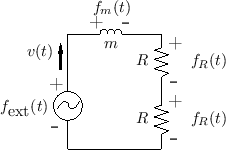 |
An advantage of the external-impulse formulation is that the system
has a zero initial state, so that an impedance description
(§7.1) is complete. In other words, the system can be
fully described as a series combination of the three impedances  ,
(on the left), and (on the right), driven by an external
force-source
,
(on the left), and (on the right), driven by an external
force-source
 .
.
Solving Eq.(9.10) for yields
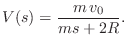
 is
is  , where
 denotes the Heaviside unit step function,10.11 the velocity of the contact point is
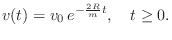 , as it must be,
and after that it decays exponentially to zero with time-constant
, as it must be,
and after that it decays exponentially to zero with time-constant
 . The decay rate depends on the ratio of the mass to the
string wave impedance. In particular, the heavier the mass, the
slower the mass velocity decays to zero. Since
. The decay rate depends on the ratio of the mass to the
string wave impedance. In particular, the heavier the mass, the
slower the mass velocity decays to zero. Since
 ,
the greater the string tension
,
the greater the string tension  or mass-density
  , the
faster the mass velocity decays to zero.
, the
faster the mass velocity decays to zero.
The displacement of the string at is given by the integral of
the velocity:
![$\displaystyle y(t,0) = \int_0^t v(\tau)\,d\tau = v_0\,\frac{m}{2R}\,\left[1-e^{-{\frac{2R}{m}t}}\right]
$](http://www.dsprelated.com/josimages_new/pasp/img2056.png)
 .
The final displacement of the string is
.
The final displacement of the string is
 .
.
The momentum of the mass before time zero is  , and after time
zero it is
, and after time
zero it is
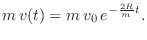
The force applied to the two string endpoints by the mass is given by
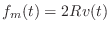 . From Newton's Law,
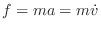 , we have that
momentum
, we have that
momentum  , delivered by the mass to the string,
can be calculated as the time integral of applied force:
, delivered by the mass to the string,
can be calculated as the time integral of applied force:
 at time infinity.
We see that an ideal string struck inelastically by a mass does not at
all correspond to an instantaneous momentum transfer, as considered in
§6.6. Instead, the mass's momentum is
transferred over a period of time (in this case infinite time). This
is why it is possible to approximate the mass width by zero in this
analysis, unlike in the excitation-by-initial-velocity in §6.6.
at time infinity.
We see that an ideal string struck inelastically by a mass does not at
all correspond to an instantaneous momentum transfer, as considered in
§6.6. Instead, the mass's momentum is
transferred over a period of time (in this case infinite time). This
is why it is possible to approximate the mass width by zero in this
analysis, unlike in the excitation-by-initial-velocity in §6.6.
In a real piano, the hammer, which strikes in an upward (grand) or sideways (upright) direction, falls away from the string a short time after collision, but it may remain in contact with the string for a substantial fraction of a period (see §9.4 on piano modeling).
Mass Termination Model
The previous discussion solved for the motion of an ideal mass striking an ideal string of infinite length. We now investigate the same model from the string's point of view. As before, we will be interested in a digital waveguide (sampled traveling-wave) model of the string, for efficiency's sake (Chapter 6), and we therefore will need to know what the mass ``looks like'' at the end of each string segment. For this we will find that the impedance description (§7.1) is especially convenient.
![\includegraphics[width=\twidth]{eps/massstringphynum}](http://www.dsprelated.com/josimages_new/pasp/img2065.png) |
Let's number the string segments to the left and right of the mass by
1 and 2, respectively, as shown in Fig.9.15. Then
Eq.(9.8) above may be written

where
 denotes the force applied by string-segment 1 to the
mass (defined as positive in the ``up'', or positive-
denotes the force applied by string-segment 1 to the
mass (defined as positive in the ``up'', or positive- direction),
 is the force applied by string-segment 2 to the mass
(again positive upwards), and denotes the inertial force applied by
the mass to both string endpoints (where again, a positive force
points up).
is the force applied by string-segment 2 to the mass
(again positive upwards), and denotes the inertial force applied by
the mass to both string endpoints (where again, a positive force
points up).
To derive the traveling-wave relations in a digital waveguide model,
we want to use the force-wave variables
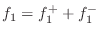 and
and
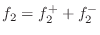 that we defined for vibrating strings in
§6.1.5; i.e., we defined
that we defined for vibrating strings in
§6.1.5; i.e., we defined
 , where is the string tension and
  is the string
slope,
is the string
slope,  .
.
![\includegraphics[width=0.5\twidth]{eps/stringslope}](http://www.dsprelated.com/josimages_new/pasp/img2073.png) |
As shown in Fig.9.16, a negative string slope pulls ``up''
to the right. Therefore, at the mass point we have
 , where
  denotes the position of the
mass along the string. On the other hand, the figure also shows that
a negative string slope pulls ``down'' to the left, so that
denotes the position of the
mass along the string. On the other hand, the figure also shows that
a negative string slope pulls ``down'' to the left, so that
 . In summary, relating the forces we
have defined for the mass-string junction to the force-wave variables
in the string, we have
. In summary, relating the forces we
have defined for the mass-string junction to the force-wave variables
in the string, we have
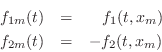
where denotes the position of the mass along the string.
Thus, we can rewrite Eq.(9.11) in terms of string wave variables as

or, substituting the definitions of these forces,

The inertial force of the mass is
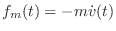 because the mass
must be accelerated downward in order to produce an upward reaction
force. The signs of the two string forces follow from the definition
of force-wave variables on the string, as discussed above.
because the mass
must be accelerated downward in order to produce an upward reaction
force. The signs of the two string forces follow from the definition
of force-wave variables on the string, as discussed above.
The force relations can be checked individually. For string 1,
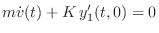
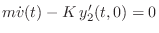
Now that we have expressed the string forces in terms of string
force-wave variables, we can derive digital waveguide models by
performing the traveling-wave decompositions
and
and using the Ohm's law relations
 and
and
 for (introduced above near
Eq.(6.6)).
for (introduced above near
Eq.(6.6)).
Mass Reflectance from Either String
Let's first consider how the mass looks from the viewpoint of string
1, assuming string 2 is at rest. In this situation (no incoming wave
from string 2), string 2 will appear to string 1 as a simple resistor
(or dashpot) of Ohms in series with the mass impedance .
(This observation will be used as the basis of a rapid solution method
in §9.3.1 below.)
When a wave from string 1 hits the mass, it will cause the mass to move. This motion carries both string endpoints along with it. Therefore, both the reflected and transmitted waves include this mass motion. We can say that we see a ``dispersive transmitted wave'' on string 2, and a dispersive reflection back onto string 1. Our object in this section is to calculate the transmission and reflection filters corresponding to these transmitted and reflected waves.
By physical symmetry the velocity reflection and transmission
will be the same from string 1 as it is from string 2. We can say the
same about force waves, but we will be more careful because the sign
of the transverse force flips when the direction of travel is
reversed.10.12Thus, we expect a scattering junction of the form shown in
Fig.9.17 (recall the discussion of physically
interacting waveguide inputs in §2.4.3). This much invokes
the superposition principle (for simultaneous reflection and transmission),
and imposes the expected symmetry: equal reflection filters
 and
equal transmission filters
and
equal transmission filters
 (for either force or velocity waves).
![\includegraphics[width=\twidth]{eps/massstringdwmform1}](http://www.dsprelated.com/josimages_new/pasp/img2087.png) |
Let's begin with Eq.(9.12) above, restated as follows:

The traveling-wave decompositions can be written out as





where a ``+'' superscript means ``right-going'' and a ``-'' superscript means ``left-going'' on either string.10.13
Let's define the mass position to be zero, so that Eq.(9.14)
with the substitutions Eq.(9.15) becomes
![$\displaystyle 0 \eqsp f_m(t) + [f^{{+}}_1(t) + f^{{-}}_1(t)] - [f^{{+}}_2(t)+f^{{-}}_2(t)] = 0.
$](http://www.dsprelated.com/josimages_new/pasp/img2096.png)

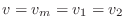 denote the common velocity of the mass and string
endpoints. Then we have
denote the common velocity of the mass and string
endpoints. Then we have
 for the mass (as discussed above
at Eq.(9.13)), and the Ohm's-law relations for the string are
and
. Making these substitutions gives
for the mass (as discussed above
at Eq.(9.13)), and the Ohm's-law relations for the string are
and
. Making these substitutions gives

In the Laplace domain, dropping the common ``(s)'' arguments,
![\begin{eqnarray*}
F_m + F^{+}_1 + F^{-}_1 - F^{+}_2 -F^{-}_2 &=& 0\\ [10pt]
\Lon...
...row\quad
-msV + RV^{+}_1 - RV^{-}_1 - RV^{+}_2 + RV^{-}_2 &=& 0.
\end{eqnarray*}](http://www.dsprelated.com/josimages_new/pasp/img2101.png)
To compute the reflection coefficient of the mass seen on string 1, we
may set  , which means
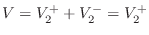 , so that we have

 , we can substitute
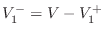 and solve for
the common velocity to get
and solve for
the common velocity to get
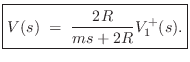
From this, the reflected velocity is immediate:

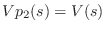 .
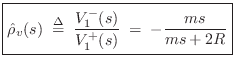
We have thus found the velocity reflection transfer function
(or velocity reflectance) of the mass as seen from string 1:
.
We have thus found the velocity reflection transfer function
(or velocity reflectance) of the mass as seen from string 1:
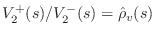 ,
i.e., the transverse-velocity reflectance is the same on either side of
the mass. Thus we have found both velocity reflection filters at the
mass-string junction. In summary, the velocity reflectance of the
mass is
,
i.e., the transverse-velocity reflectance is the same on either side of
the mass. Thus we have found both velocity reflection filters at the
mass-string junction. In summary, the velocity reflectance of the
mass is
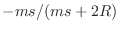 from either string segment. This is a simple
first-order filter model of what the mass (and string beyond) looks
like dynamically from either string.
from either string segment. This is a simple
first-order filter model of what the mass (and string beyond) looks
like dynamically from either string.
It is always good to check that our answers make physical sense in
limiting cases. For this problem, easy cases to check are  and
and
 . When the mass is , the reflectance goes to zero (no
reflected wave at all). When the mass goes to infinity, the
reflectance approaches
. When the mass is , the reflectance goes to zero (no
reflected wave at all). When the mass goes to infinity, the
reflectance approaches
 , corresponding to a rigid
termination, which also makes sense.
, corresponding to a rigid
termination, which also makes sense.
The results of this section can be more quickly obtained as a special
case of the main result of §C.12, by choosing  waveguides meeting at a load
impedance
waveguides meeting at a load
impedance  . The next section gives another
fast-calculation method based on a standard formula.
. The next section gives another
fast-calculation method based on a standard formula.
Simplified Impedance Analysis
The above results are quickly derived from the general reflection-coefficient for force waves (or voltage waves, pressure waves, etc.):
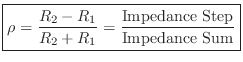
where
 is the reflection coefficient of impedance
  as
``seen'' from impedance
as
``seen'' from impedance  . If a force wave
  traveling along in impedance suddenly hits a new impedance
, the wave will split into a reflected wave
traveling along in impedance suddenly hits a new impedance
, the wave will split into a reflected wave
 , and a
transmitted wave
, and a
transmitted wave
 . It therefore follows that a velocity
wave
. It therefore follows that a velocity
wave  will split into a reflected wave
 and
transmitted wave
and
transmitted wave
 . This rule is derived in
§C.8.4 (and
implicitly above as well).
. This rule is derived in
§C.8.4 (and
implicitly above as well).
In the mass-string-collision problem, we can immediately write down the force reflectance of the mass as seen from either string:
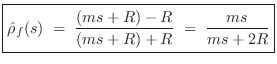 , and when they hit the mass, they are hitting the series
combination of the mass impedance and the wave impedance
of the string on the other side of the mass. Thus, in terms of
Eq.(9.17) above,
, and when they hit the mass, they are hitting the series
combination of the mass impedance and the wave impedance
of the string on the other side of the mass. Thus, in terms of
Eq.(9.17) above,  and
and  .
.
Since, by the Ohm's-law relations,

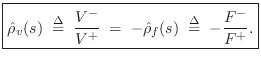
Mass Transmittance from String to String
Referring to Fig.9.15, the velocity transmittance from string 1 to string 2 may be defined as

 .
Assuming the incoming wave
.
Assuming the incoming wave  on string 2 is zero, we have
 , which we found in Eq.(9.16):

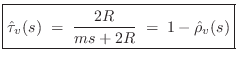
 corresponds to
 , as befits a
rigid termination. As
, as befits a
rigid termination. As  , the transmittance becomes 1 and the
mass has no effect, as desired.
, the transmittance becomes 1 and the
mass has no effect, as desired.
We can now refine the picture of our scattering junction Fig.9.17 to obtain the form shown in Fig.9.18.
![\includegraphics[width=0.8\twidth]{eps/massstringdwmformvel}](http://www.dsprelated.com/josimages_new/pasp/img2139.png) |
Force Wave Mass-String Model
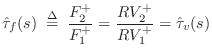
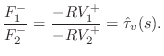
The velocity transmittance is readily converted to a force transmittance using the Ohm's-law relations:
![\includegraphics[width=0.8\twidth]{eps/massstringdwmformforce}](http://www.dsprelated.com/josimages_new/pasp/img2142.png) |
Checking as before, we see that
corresponds to
, which means no force is transmitted through an
infinite mass, which is reasonable. As , the force
transmittance becomes 1 and the mass has no effect, as desired.
Summary of Mass-String Scattering Junction
In summary, we have characterized the mass on the string in terms of its reflectance and transmittance from either string. For force waves, we have outgoing waves given by

or
![$\displaystyle \left[\begin{array}{c} F^{+}_2 \\ [2pt] F^{-}_1 \end{array}\right...
...ay}\right] \left[\begin{array}{c} F^{+}_1 \\ [2pt] F^{-}_2 \end{array}\right]
$](http://www.dsprelated.com/josimages_new/pasp/img2144.png)
 and
and  , the force
reflectance
, the force
reflectance
 , and the force transmittance
 . We may say that the mass
creates a dynamic scattering junction on the string. (If there
were no dependency on
. We may say that the mass
creates a dynamic scattering junction on the string. (If there
were no dependency on  , such as when a dashpot is affixed to the
string, we would simply call it a scattering junction.) The
above form of the dynamic scattering junction is analogous to the
Kelly-Lochbaum scattering junction (§C.8.4).
The general relation
, such as when a dashpot is affixed to the
string, we would simply call it a scattering junction.) The
above form of the dynamic scattering junction is analogous to the
Kelly-Lochbaum scattering junction (§C.8.4).
The general relation
 can be used to simplify the
Kelly-Lochbaum form to a one-filter scattering junction
analogous to the one-multiply scattering junction (§C.8.5):
can be used to simplify the
Kelly-Lochbaum form to a one-filter scattering junction
analogous to the one-multiply scattering junction (§C.8.5):

The one-filter form follows from the observation that
 appears in both computations, and therefore need only be implemented once:
![\begin{eqnarray*}
F^{+}&\isdef & \hat{\rho}_f\cdot(F^{+}_1+F^{-}_2)\\ [5pt]
F^{-}_1 &=& F^{-}_2 + F^{+}\\ [5pt]
F^{+}_2 &=& F^{+}_1 + F^{+}
\end{eqnarray*}](http://www.dsprelated.com/josimages_new/pasp/img2152.png)
This structure is diagrammed in Fig.9.20.
![\includegraphics[width=\twidth]{eps/massstringdwms}](http://www.dsprelated.com/josimages_new/pasp/img2153.png) |
Again, the above results follow immediately from the more general formulation of §C.12.
Digital Waveguide Mass-String Model
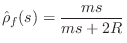
To obtain a force-wave digital waveguide model of the string-mass assembly after the mass has struck the string, it only remains to digitize the model of Fig.9.20. The delays are obviously to be implemented using digital delay lines. For the mass, we must digitize the force reflectance appearing in the one-filter model of Fig.9.20:
A common choice of digitization method is the bilinear transform (§7.3.2) because it preserves losslessness and does not alias. This will effectively yield a wave digital filter model for the mass in this context (see Appendix F for a tutorial on wave digital filters).
The bilinear transform is typically scaled as
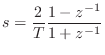
 denotes the sampling interval. This choice optimizes the
low-frequency match between the digital and analog mass frequency responses.
Rewriting Eq.(9.18) as
denotes the sampling interval. This choice optimizes the
low-frequency match between the digital and analog mass frequency responses.
Rewriting Eq.(9.18) as
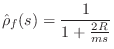
![\begin{eqnarray*}
\hat{\rho}_d(z)
&=& \frac{1}{1+\frac{2R}{m}\frac{T}{2}\frac{1+z^{-1}}{1-z^{-1}}}\\ [5pt]
&=& g\frac{1-z^{-1}}{1-pz^{-1}}
\end{eqnarray*}](http://www.dsprelated.com/josimages_new/pasp/img2157.png)
where the gain coefficient  and pole
  are given by
![\begin{eqnarray*}
g&\isdef &\frac{1}{1+\frac{RT}{m}}\;<\;1\\ [5pt]
p&\isdef &\frac{1-\frac{RT}{m}}{1+\frac{RT}{m}}\;<\;1.
\end{eqnarray*}](http://www.dsprelated.com/josimages_new/pasp/img2158.png)
Thus, the reflectance of the mass is a one-pole, one-zero filter. The
zero is exactly at dc, the real pole is close to dc, and the gain at
half the sampling rate is  . We may recognize this as the classic
dc-blocking filter
[449]. Comparing with Eq.(9.18), we see that the behavior
at dc is correct, and that the behavior at infinite frequency
(
. We may recognize this as the classic
dc-blocking filter
[449]. Comparing with Eq.(9.18), we see that the behavior
at dc is correct, and that the behavior at infinite frequency
(
 ) is now the behavior at half the sampling rate
(
) is now the behavior at half the sampling rate
(
 ).
).
Physically, the mass reflectance is zero at dc because sufficiently slow waves can freely move a mass of any finite size. The reflectance is 1 at infinite frequency because there is no time for the mass to start moving before it is pushed in the opposite direction. In short, a mass behaves like a rigid termination at infinite frequency, and a free end (no termination) at zero frequency. The reflectance of a mass is therefore a ``dc blocker''.
The final digital waveguide model of the mass-string combination is shown in Fig.9.21.
![\includegraphics[width=\twidth]{eps/massstringdwmz}](http://www.dsprelated.com/josimages_new/pasp/img2161.png)
Additional examples of lumped-element modeling, including masses, springs, dashpots, and their various interconnections, are discussed the Wave Digital Filters (WDF) appendix (Appendix F). A nice feature WDFs is that they employ traveling-wave input/output signals which are ideal for interfacing to digital waveguides. The main drawback is that the WDFs operate over a warped frequency axis (due to the bilinear transform), while digital delay lines have a normal (unwarped) frequency axis. On the plus side, WDFs cannot alias, while digital waveguides do alias in the frequency domain for signals that are not bandlimited to less than half the sampling rate. At low frequencies (or given sufficient oversampling), the WDF frequency warping is minimal, and in such cases, WDF ``lumped element models'' may be connected directly to digital waveguides, which are ``sampled-wave distributed parameter'' models.
Even when the bilinear-transform frequency-warping is severe, it is often well tolerated when the frequency response has only one ``important frequency'', such as a second-order resonator, lowpass, or highpass response. In other words, the bilinear transform can be scaled to map any single analog frequency to any desired corresponding digital frequency (see §7.3.2 for details), and the frequency-warped responses above and below the exactly mapped frequency may ``sound as good as'' the unwarped responses for musical purposes. If not, higher order filters can be used to model lumped elements (Chapter 7).
Displacement-Wave Simulation
As discussed in [121], displacement waves
are often preferred over force or velocity waves for guitar-string
simulations, because such strings often hit obstacles such as frets or
the neck. To obtain displacement from velocity at a given  ,
we may time-integrate
velocity as above to produce displacement at any spatial sample along the
string where a collision might be possible. However, all these
integrators can be eliminated by simply going to a displacement-wave
simulation, as has been done in nearly all papers to date on plucking
models for digital waveguide strings.
,
we may time-integrate
velocity as above to produce displacement at any spatial sample along the
string where a collision might be possible. However, all these
integrators can be eliminated by simply going to a displacement-wave
simulation, as has been done in nearly all papers to date on plucking
models for digital waveguide strings.
To convert our force-wave simulation to a displacement-wave
simulation, we may first convert force to velocity using the Ohm's law
relations
and
and then
conceptually integrate all signals with respect to time (in advance of
the simulation).
is the same on both sides of the finger-junction, which means we
can convert from force to velocity by simply negating all left-going
signals. (Conceptually, all signals are converted from force to
velocity by the Ohm's law relations and then divided by , but the
common scaling by  can be omitted (or postponed) unless signal
values are desired in particular physical units.) An
all-velocity-wave simulation can be converted to displacement waves
even more easily by simply changing
can be omitted (or postponed) unless signal
values are desired in particular physical units.) An
all-velocity-wave simulation can be converted to displacement waves
even more easily by simply changing  to everywhere, because
velocity and displacement waves scatter identically. In more general
situations, we can go to the Laplace domain and replace each
occurrence of
to everywhere, because
velocity and displacement waves scatter identically. In more general
situations, we can go to the Laplace domain and replace each
occurrence of  by
by  , each
  by
by  ,
divide all signals by , push any leftover around for maximum
simplification, perhaps absorbing it into a nearby filter. In an
all-velocity-wave simulation, each signal gets multiplied by in
this procedure, which means it cancels out of all definable transfer
functions. All filters in the diagram (just
,
divide all signals by , push any leftover around for maximum
simplification, perhaps absorbing it into a nearby filter. In an
all-velocity-wave simulation, each signal gets multiplied by in
this procedure, which means it cancels out of all definable transfer
functions. All filters in the diagram (just
 in this
example) can be left alone because their inputs and outputs are still
force-valued in principle. (We expressed each force wave in terms of
velocity and wave impedance without changing the signal flow diagram,
which remains a force-wave simulation until minus signs, scalings, and
operators are moved around and combined.) Of course, one can
absorb scalings and sign reversals into the filter(s) to change the
physical input/output units as desired. Since we routinely assume
zero initial conditions in an impedance description, the integration
constants obtained by time-integrating velocities to get displacements
are all defined to be zero. Additional considerations regarding the
choice of displacement waves over velocity (or force) waves are given
in §E.3.3. In particular, their initial conditions can be very
different, and traveling-wave components tend not to be as well
behaved for displacement waves.
in this
example) can be left alone because their inputs and outputs are still
force-valued in principle. (We expressed each force wave in terms of
velocity and wave impedance without changing the signal flow diagram,
which remains a force-wave simulation until minus signs, scalings, and
operators are moved around and combined.) Of course, one can
absorb scalings and sign reversals into the filter(s) to change the
physical input/output units as desired. Since we routinely assume
zero initial conditions in an impedance description, the integration
constants obtained by time-integrating velocities to get displacements
are all defined to be zero. Additional considerations regarding the
choice of displacement waves over velocity (or force) waves are given
in §E.3.3. In particular, their initial conditions can be very
different, and traveling-wave components tend not to be as well
behaved for displacement waves.
Next Section:
Piano Hammer Modeling
Previous Section:
Body Modeling











