







One-Multiply Scattering Junctions
By factoring out  in each equation of (C.60), we can write


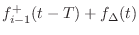


where
![$\displaystyle f_{{\Delta}}(t) \isdef k_i(t)\left[f^{{+}}_{i-1}(t-T) - f^{{-}}_i(t) \right]$](http://www.dsprelated.com/josimages_new/pasp/img3615.png)
Thus, only one multiplication is actually necessary to compute the transmitted and reflected waves from the incoming waves in the Kelly-Lochbaum junction. This computation is shown in Fig.C.21, and it is known as the one-multiply scattering junction [297].
![\includegraphics[scale=0.9]{eps/Fom}](http://www.dsprelated.com/josimages_new/pasp/img3616.png)
Another one-multiply form is obtained by organizing (C.60) as
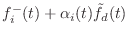

where


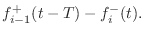
As in the previous case, only one multiplication and three additions are required per junction. This one-multiply form generalizes more readily to junctions of more than two waveguides, as we'll see in a later section.
A scattering junction well known in the LPC speech literature but not described here is the so-called two-multiply junction [297] (requiring also two additions). This omission is because the two-multiply junction is not valid as a general, local, physical modeling building block. Its derivation is tied to the reflectively terminated, cascade waveguide chain. In cases where it applies, however, it can be the implementation of choice; for example, in DSP chips having a fast multiply-add instruction, it may be possible to implement the inner loop of the two-multiply, two-add scattering junction using only two instructions.
Next Section:
Normalized Scattering Junctions
Previous Section:
Kelly-Lochbaum Scattering Junctions












