







Kelly-Lochbaum Scattering Junctions
Conservation of energy and mass dictate that, at the impedance
discontinuity, force and velocity variables must be continuous


where velocity is defined as positive to the right on both sides of the junction. Force (or stress or pressure) is a scalar while velocity is a vector with both a magnitude and direction (in this case only left or right). Equations (C.57), (C.58), and (C.59) imply the following scattering equations (a derivation is given in the next section for the more general case of
 waveguides meeting at a junction):

![$\displaystyle \left[1+k_i(t) \right]f^{{+}}_{i-1}(t-T) - k_i(t) f^{{-}}_i(t)$](http://www.dsprelated.com/josimages_new/pasp/img3603.png)

![$\displaystyle k_i(t)f^{{+}}_{i-1}(t-T) + \left[1-k_i(t)\right]f^{{-}}_i(t)$](http://www.dsprelated.com/josimages_new/pasp/img3605.png)
where
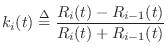
is called the
 th reflection coefficient. Since
 , we have
![$ k_i(t)\in[-1,1]$](http://www.dsprelated.com/josimages_new/pasp/img3608.png) . It can be shown that if
. It can be shown that if
 , then either
  or
or  is negative, and this
implies an active (as opposed to passive) medium. Correspondingly,
lattice and ladder recursive digital filters are stable if and
only if all reflection coefficients are bounded by
is negative, and this
implies an active (as opposed to passive) medium. Correspondingly,
lattice and ladder recursive digital filters are stable if and
only if all reflection coefficients are bounded by  in magnitude
[297].
in magnitude
[297].
![\includegraphics[scale=0.9]{eps/Fkl}](http://www.dsprelated.com/josimages_new/pasp/img3611.png)
The scattering equations are illustrated in Figs. C.19b and C.20. In linear predictive coding of speech [482], this structure is called the Kelly-Lochbaum scattering junction, and it is one of several types of scattering junction used to implement lattice and ladder digital filter structures (§C.9.4,[297]).
Next Section:
One-Multiply Scattering Junctions
Previous Section:
Longitudinal Waves in Rods












