







Reflection Free Port
It is useful in practice, such as when connecting two adaptors
together, to make one port reflection free. A
reflection-free port is defined to have a zero reflection coefficient. For port
 of a parallel adaptor to be reflection free, we must have, from
Eq.
of a parallel adaptor to be reflection free, we must have, from
Eq. (F.25),
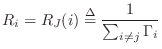
Connecting two adaptors at a reflection-free port prevents the formation of a delay-free loop which would otherwise occur [136]. As a result, multi-port junctions can be joined without having to insert unit elements (see §F.1.7) to avoid creating delay-free loops. Only one of the two ports participating in the connection needs to be reflection free.
We can always make a reflection-free port at the connection of two adaptors because the ports used for this connection (one on each adaptor) were created only for purposes of this connection. They can be set to any impedance, and only one of them needs to be reflection free.
To interconnect three adaptors, labeled  ,
,  , and
, and  , we may
proceed as follows: Let be augmented with two unconstrained
ports, having impedances
, we may
proceed as follows: Let be augmented with two unconstrained
ports, having impedances  and
and  . Add a reflection-free
port to , and suppose its impedance has to be
. Add a reflection-free
port to , and suppose its impedance has to be  . Add a
reflection-free port to , and suppose its impedance has to be
. Add a
reflection-free port to , and suppose its impedance has to be
 . Now set
  and connect to via the
corresponding ports. Similarly, set
and connect to via the
corresponding ports. Similarly, set  and connect to
accordingly. This adaptor-connection protocol clearly extends to any
number of adaptors.
and connect to
accordingly. This adaptor-connection protocol clearly extends to any
number of adaptors.
Next Section:
Beta Parameters
Previous Section:
Physical Derivation of Reflection Coefficient












