







Root-Power Waves
It is sometimes helpful to normalize the wave variables so that signal power is uniformly distributed numerically. This can be especially helpful in fixed-point implementations.
From (C.49), it is clear that power normalization is given by
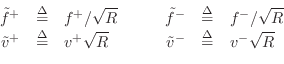
where we have dropped the common time argument `
 ' for simplicity.
As a result, we obtain
' for simplicity.
As a result, we obtain
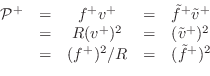 |
and
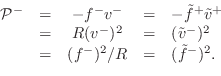 |
The normalized wave variables
 and
and
 behave physically like
force and velocity waves, respectively, but they are scaled such that
either can be squared to obtain instantaneous signal power. Waveguide
networks built using normalized waves have many desirable properties
[174,172,432]. One is the obvious numerical
advantage of uniformly distributing signal power across available dynamic
range in fixed-point implementations. Another is that only in the
normalized case can the wave impedances be made time varying without modulating
signal power. In other words, use of normalized waves eliminates
``parametric amplification'' effects; signal power is decoupled from
parameter changes.
behave physically like
force and velocity waves, respectively, but they are scaled such that
either can be squared to obtain instantaneous signal power. Waveguide
networks built using normalized waves have many desirable properties
[174,172,432]. One is the obvious numerical
advantage of uniformly distributing signal power across available dynamic
range in fixed-point implementations. Another is that only in the
normalized case can the wave impedances be made time varying without modulating
signal power. In other words, use of normalized waves eliminates
``parametric amplification'' effects; signal power is decoupled from
parameter changes.
Next Section:
Total Energy in a Rigidly Terminated String
Previous Section:
Energy Density Waves












