







Special Cases
In the limiting case of  , the input and output sampling rates are
equal, and all sidelobes of the frequency response
, the input and output sampling rates are
equal, and all sidelobes of the frequency response  (partially
shown in Fig.4.9) alias into the main lobe.
(partially
shown in Fig.4.9) alias into the main lobe.
If the output is sampled at the same exact time instants as the input
signal, the input and output are identical. In terms of the aliasing
picture of the previous section, the frequency response aliases to a
perfect flat response over
![$ fT\in[-1,1]$](http://www.dsprelated.com/josimages_new/pasp/img993.png) , with all spectral images
combining coherently under the flat gain. It is important in this
reconstruction that, while the frequency response of the underlying
continuous interpolating filter is aliased by sampling, the signal
spectrum is only imaged--not aliased; this is true for all positive
integers
, with all spectral images
combining coherently under the flat gain. It is important in this
reconstruction that, while the frequency response of the underlying
continuous interpolating filter is aliased by sampling, the signal
spectrum is only imaged--not aliased; this is true for all positive
integers  and
and  in Fig.4.7.
More typically, when linear interpolation is used to provide
fractional delay, identity is not obtained. Referring again to
Fig.4.7, with considered to be so large that it is
effectively infinite, fractional-delay by  can be modeled as
convolving the samples
can be modeled as
convolving the samples  with
with
 followed by sampling
at
followed by sampling
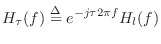
at  . In this case, a linear phase term has been introduced in
the interpolator frequency response, giving,
. In this case, a linear phase term has been introduced in
the interpolator frequency response, giving,
 (when
(when
 is non-integer). Moreover, the phase response is
nonlinear as well; a sampled symmetric triangular pulse is only
linear phase when the samples fall symmetrically about the midpoint.
Some example frequency-responses for various delays are graphed
in Fig.4.2.
is non-integer). Moreover, the phase response is
nonlinear as well; a sampled symmetric triangular pulse is only
linear phase when the samples fall symmetrically about the midpoint.
Some example frequency-responses for various delays are graphed
in Fig.4.2.
Next Section:
Orders 1 to 5 on a fractional delay of 0.4 samples
Previous Section:
Linear Interpolation Frequency Response












