







Ideal Spectral Interpolation
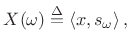
Ideally, the spectrum of any signal  at any frequency
 is obtained by projecting the signal
  onto the
zero-phase, unit-amplitude, complex sinusoid at frequency
onto the
zero-phase, unit-amplitude, complex sinusoid at frequency  [264]:
 |
(3.43) |
where
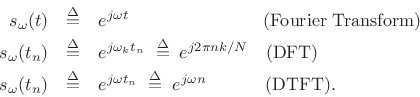
Thus, for signals in the DTFT domain which are time limited to
![$ n\in[-N/2,N/2-1]$](http://www.dsprelated.com/josimages_new/sasp2/img257.png) ,
we obtain
,
we obtain
 |
(3.44) |
This can be thought of as a zero-centered DFT evaluated at
 instead of
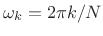 for some
![$ k\in[0,N-1]$](http://www.dsprelated.com/josimages_new/sasp2/img101.png) . It arises naturally from taking the DTFT of a
finite-length signal. Such time-limited signals may be said to have
``finite support'' [175].
. It arises naturally from taking the DTFT of a
finite-length signal. Such time-limited signals may be said to have
``finite support'' [175].
Next Section:
Interpolating a DFT
Previous Section:
Spectral Roll-Off












