Quadratic Interpolation of Spectral Peaks
In quadratic interpolation of sinusoidal spectrum-analysis peaks, we replace the main lobe of our window transform by a quadratic polynomial, or ``parabola''. This is valid for any practical window transform in a sufficiently small neighborhood about the peak, because the higher order terms in a Taylor series expansion about the peak converge to zero as the peak is approached.
Note that, as mentioned in §D.1, the Gaussian window transform magnitude is precisely a parabola on a dB scale. As a result, quadratic spectral peak interpolation is exact under the Gaussian window. Of course, we must somehow remove the infinitely long tails of the Gaussian window in practice, but this does not cause much deviation from a parabola, as shown in Fig.3.36.
![\begin{psfrags}
% latex2html id marker 16827\psfrag{a} []{ \Large$ \alpha $}\psfrag{b} []{ \Large$ \beta $}\psfrag{g} []{ \Large$ \gamma $\ }\begin{figure}[htbp]
\includegraphics[width=\textwidth ]{eps/parabola}
\caption{Illustration of
parabolic peak interpolation using the three samples nearest the peak.}
\end{figure}
\end{psfrags}](http://www.dsprelated.com/josimages_new/sasp2/img1007.png)
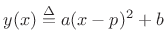
Referring to Fig.5.15, the general formula for a parabola may be written as
 |
(6.29) |
The center point
 gives us our interpolated peak location (in
bins), while the amplitude
gives us our interpolated peak location (in
bins), while the amplitude  equals the peak amplitude (typically
in dB). The curvature
equals the peak amplitude (typically
in dB). The curvature  depends on the window used and contains no
information about the sinusoid. (It may, however, indicate that the
peak being interpolated is not a pure sinusoid.)
depends on the window used and contains no
information about the sinusoid. (It may, however, indicate that the
peak being interpolated is not a pure sinusoid.)
At the three samples nearest the peak, we have
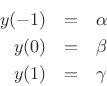
where we arbitrarily renumbered the bins about the peak  , 0, and 1.
Writing the three samples in terms of the interpolating parabola gives
, 0, and 1.
Writing the three samples in terms of the interpolating parabola gives
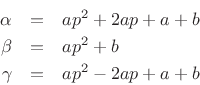
which implies
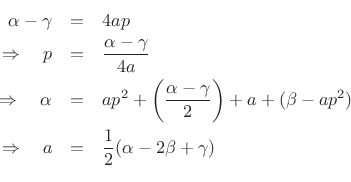
Hence, the interpolated peak location is given in bins6.9 (spectral samples) by
![$\displaystyle \zbox {p=\frac{1}{2}\frac{\alpha-\gamma}{\alpha-2\beta+\gamma}} \in [-1/2,1/2].$](http://www.dsprelated.com/josimages_new/sasp2/img1015.png) |
(6.30) |
If
 denotes the bin number of the largest spectral sample at
the peak, then
denotes the bin number of the largest spectral sample at
the peak, then  is the interpolated peak location in bins.
The final interpolated frequency estimate is then
is the interpolated peak location in bins.
The final interpolated frequency estimate is then
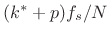 Hz, where
  denotes the sampling rate and
  is the FFT size.
Using the interpolated peak location, the peak magnitude estimate is
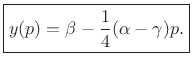 |
(6.31) |
Phase Interpolation at a Peak
Note that only the spectral magnitude is used to find
in
the parabolic interpolation scheme of the previous section. In some
applications, a phase interpolation is also desired.
In principle, phase interpolation is independent of magnitude interpolation, and any interpolation method can be used. There is usually no reason to expect a ``phase peak'' at a magnitude peak, so simple linear interpolation may be used to interpolate the unwrapped phase samples (given a sufficiently large zero-padding factor). Matlab has an unwrap function for unwrapping phase, and §F.4 provides an Octave-compatible version.
If we do expect a phase peak (such as when identifying chirps, as discussed in §10.6), then we may use quadratic interpolation separately on the (unwrapped) phase.
Alternatively, the real and imaginary parts can be interpolated separately to yield a complex peak value estimate.
Matlab for Parabolic Peak Interpolation
Section §F.2 lists Matlab/Octave code for finding quadratically interpolated peaks in the magnitude spectrum as discussed above. At the heart is the qint function, which contains the following:
function [p,y,a] = qint(ym1,y0,yp1)
%QINT - quadratic interpolation of three adjacent samples
%
% [p,y,a] = qint(ym1,y0,yp1)
%
% returns the extremum location p, height y, and half-curvature a
% of a parabolic fit through three points.
% Parabola is given by y(x) = a*(x-p)^2+b,
% where y(-1)=ym1, y(0)=y0, y(1)=yp1.

p = (yp1 - ym1)/(2*(2*y0 - yp1 - ym1));
y = y0 - 0.25*(ym1-yp1)*p;
a = 0.5*(ym1 - 2*y0 + yp1);
Next Section:
Bias of Parabolic Peak Interpolation
Previous Section:
Summary