







Modelling a Noisy Communication Signal in MATLAB for the Analog to Digital Conversion Process
A critical thing to realize while modeling the signal that is going to be digitally processed is the SNR. In a receiver, the noise floor (hence the noise variance and hence its power) are determined by the temperature and the Bandwidth. For a system with a constant bandwidth, relatively constant temperature, the noise power remains relatively constant as well. This implies that the noise variance is a constant.
In MATLAB, the easiest way to create a noisy signal is by using awgn(sig,SNR,'measured'). Or, this has been the method that I have used extensively to generate a noisy signal. Earlier, I failed to realize that this was not correctly modeling the signal that I wanted to process. Using awgn will produce noise after measuring the signal power.
Let me explain with an example. Say that we have generated a signal in MATLAB with variance of 0.5. Suppose we wanted SNR of 0dB, in MATLAB we would simply have y = awgn(sig,0,'measured').
If we measured the var(sig-y) we would end up with an answer of 0.5.
Let us follow the rest of the explanation in the pdf attached
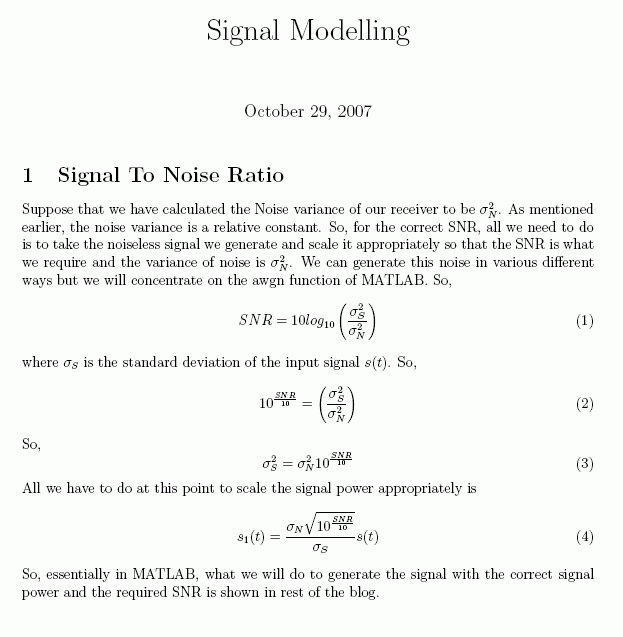
The following short MATLAB script generates the noisy signal:
% Inputs: SNR Value, the Variance of the Noise of the reciever and the
% original sig
% Outputs: The noisy signal and the noise with the required noise variance
function [sign, noise] = sig_model(SNR, noise_var, sig)
sig_std = std(sig);
y = sqrt(noise_var)*sqrt(10^(SNR/10))*sig/sig_std;
sig_variance = var(sig)
scaled_signal_variance = var(y)
sign = awgn(y,SNR,'measured');
noise = sign-y;
noise_variance = var(noise)
Above script will generate the model of the analog signal that will hit the front end of the ADC. In the next blog, I will investigate the effects of the ADC process on this noisy signal.


- Comments
- Write a Comment Select to add a comment

Look for Guassian Distribution and related stuff. As u r doing MSEE, for Communication there is a prereq. "Random Variables and Stochastic Processes" , that deals with all ur questions, mean, variance, etc.
What u said is true if a signal is distorted by Guassian noise, that is usually the case and a presumption in your case

To post reply to a comment, click on the 'reply' button attached to each comment. To post a new comment (not a reply to a comment) check out the 'Write a Comment' tab at the top of the comments.
Please login (on the right) if you already have an account on this platform.
Otherwise, please use this form to register (free) an join one of the largest online community for Electrical/Embedded/DSP/FPGA/ML engineers:










