







The Biquad Allpass Section
The general biquad transfer function was given in Eq. (B.8) to be
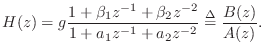
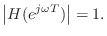
 , the numerator
  must be, in the
real case,B.3
must be, in the
real case,B.3

 ,
,
 , and
, and
 .
.
In terms of the poles and zeros of a filter
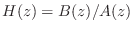 , an
allpass filter must have a zero at
, an
allpass filter must have a zero at  for each pole at
  .
That is if the denominator satisfies
.
That is if the denominator satisfies  , then the
numerator polynomial must satisfy
, then the
numerator polynomial must satisfy  . (Show this in
the one-pole case.) Therefore, defining
. (Show this in
the one-pole case.) Therefore, defining
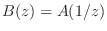 takes care of
this property for all roots of (all poles). However, since we
prefer that be a polynomial in
takes care of
this property for all roots of (all poles). However, since we
prefer that be a polynomial in  , we define
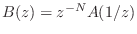 , where
  is the order of (the number of poles).
is then the flip of .
is the order of (the number of poles).
is then the flip of .
For further discussion and examples of allpass filters (including muli-input, multi-output allpass filters), see Appendix C. Analog allpass filters are defined and discussed in §E.8.
Next Section:
Allpass Filter Design
Previous Section:
Biquad Software Implementations












