







Derivation of Group Delay as Modulation Delay
Suppose we write a narrowband signal centered at frequency  as
as
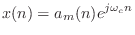
where
is defined as the carrier frequency (in
radians per sample), and  is some ``lowpass'' amplitude
modulation signal. The modulation
is some ``lowpass'' amplitude
modulation signal. The modulation  can be complex-valued to
represent either phase or amplitude modulation or both. By
``lowpass,'' we mean that the spectrum of is concentrated
near dc, i.e.,
can be complex-valued to
represent either phase or amplitude modulation or both. By
``lowpass,'' we mean that the spectrum of is concentrated
near dc, i.e.,

 . The modulation bandwidth is thus
bounded by
. The modulation bandwidth is thus
bounded by
 .
.
Using the above frequency-domain expansion of ,  can be
written as
can be
written as
![$\displaystyle x(n) \eqsp a_m(n) e^{j\omega_c n} \eqsp
\left[\frac{1}{2\pi} \int_{-\epsilon}^{\epsilon} A_m(\omega)e^{j\omega n} d\omega\right] e^{j\omega_c n},
$](http://www.dsprelated.com/josimages_new/filters/img908.png)

 near 0. Let us now pass the frequency component
 through an LTI filter
  having frequency response
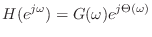
![$\displaystyle y_\omega(n) = \left[G(\omega_c+\omega)A_m(\omega)\right] e^{j[(\omega_c +\omega) n + \Theta(\omega_c+\omega)]}. \protect$](http://www.dsprelated.com/josimages_new/filters/img912.png)
Assuming the phase response
 is approximately linear
over the narrow frequency interval
is approximately linear
over the narrow frequency interval
![$ \omega\in[\omega_c-\epsilon,\omega_c+\epsilon]$](http://www.dsprelated.com/josimages_new/filters/img913.png) , we can write
, we can write

 is the filter group delay at .
Making this substitution in Eq.
is the filter group delay at .
Making this substitution in Eq. (7.7) gives
![\begin{eqnarray*}
y_\omega(n)
&=& \left[G(\omega_c+\omega)A_m(\omega)\right]
e^...
...\right]
e^{j\omega[n-D(\omega_c)]} e^{j\omega_c[n-P(\omega_c)]},
\end{eqnarray*}](http://www.dsprelated.com/josimages_new/filters/img916.png)
where we also used the definition of phase delay,
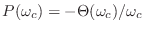 , in the last step. In this expression we
can already see that the carrier sinusoid is delayed by the phase
delay, while the amplitude-envelope frequency-component is delayed by
the group delay. Integrating over to recombine the
sinusoidal components (i.e., using a Fourier superposition integral for
, in the last step. In this expression we
can already see that the carrier sinusoid is delayed by the phase
delay, while the amplitude-envelope frequency-component is delayed by
the group delay. Integrating over to recombine the
sinusoidal components (i.e., using a Fourier superposition integral for
 ) gives
![\begin{eqnarray*}
y(n) &=& \frac{1}{2\pi}\int_{\omega} y_\omega(n) d\omega \\
&...
...)]}\\
&=& a^f[n-D(\omega_c)] \cdot e^{j\omega_c[n-P(\omega_c)]}
\end{eqnarray*}](http://www.dsprelated.com/josimages_new/filters/img918.png)
where  denotes a zero-phase filtering of the amplitude
envelope
denotes a zero-phase filtering of the amplitude
envelope  by
by
 . We see that the amplitude
modulation is delayed by
while the carrier wave is
delayed by
. We see that the amplitude
modulation is delayed by
while the carrier wave is
delayed by
 .
.
We have shown that, for narrowband signals expressed as in
Eq.(7.6) as a modulation envelope times a sinusoidal carrier, the
carrier wave is delayed by the filter phase delay, while the
modulation is delayed by the filter group delay, provided that the
filter phase response is approximately linear over the narrowband
frequency interval.
Next Section:
Two's Complement Wrap-Around
Previous Section:
Separating the Transfer Function Numerator and Denominator












