Example Sinusoids
Figure 4.1 plots the sinusoid
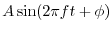 , for
, for  ,
,  ,
,
 , and
, and
![$ t\in[0,1]$](http://www.dsprelated.com/josimages_new/mdft/img385.png) . Study the plot to make sure you understand the effect of
changing each parameter (amplitude, frequency, phase), and also note the
definitions of ``peak-to-peak amplitude'' and ``zero crossings.''
. Study the plot to make sure you understand the effect of
changing each parameter (amplitude, frequency, phase), and also note the
definitions of ``peak-to-peak amplitude'' and ``zero crossings.''
![\includegraphics[width=\twidth]{eps/sine}](http://www.dsprelated.com/josimages_new/mdft/img386.png)
A ``tuning fork'' vibrates approximately sinusoidally. An ``A-440'' tuning
fork oscillates at  cycles per second. As a result, a tone recorded
from an ideal A-440 tuning fork is a sinusoid at
cycles per second. As a result, a tone recorded
from an ideal A-440 tuning fork is a sinusoid at  Hz. The amplitude
 determines how loud it is and depends on how hard we strike the tuning
fork. The phase
determines how loud it is and depends on how hard we strike the tuning
fork. The phase  is set by exactly when we strike the tuning
fork (and on our choice of when time 0 is). If we record an A-440 tuning
fork on an analog tape recorder, the electrical signal recorded on tape is
of the form
is set by exactly when we strike the tuning
fork (and on our choice of when time 0 is). If we record an A-440 tuning
fork on an analog tape recorder, the electrical signal recorded on tape is
of the form

As another example, the sinusoid at amplitude  and phase
  (90 degrees)
is simply
(90 degrees)
is simply

 is a sinusoid at phase 90-degrees, while
 is a sinusoid at zero phase. Note, however, that we could
just as well have defined
to be the zero-phase sinusoid
rather than
. It really doesn't matter, except to be
consistent in any given usage. The concept of a ``sinusoidal signal''
is simply that it is equal to a sine or cosine function at some amplitude,
frequency, and phase. It does not matter whether we choose
is a sinusoid at zero phase. Note, however, that we could
just as well have defined
to be the zero-phase sinusoid
rather than
. It really doesn't matter, except to be
consistent in any given usage. The concept of a ``sinusoidal signal''
is simply that it is equal to a sine or cosine function at some amplitude,
frequency, and phase. It does not matter whether we choose  or
or  in the ``official'' definition of a sinusoid. You may
encounter both definitions. Using is nice since
``sinusoid'' naturally generalizes . However, using is
nicer when defining a sinusoid to be the real part of a complex sinusoid
(which we'll talk about in §4.3.11).
in the ``official'' definition of a sinusoid. You may
encounter both definitions. Using is nice since
``sinusoid'' naturally generalizes . However, using is
nicer when defining a sinusoid to be the real part of a complex sinusoid
(which we'll talk about in §4.3.11).
Next Section:
Why Sinusoids are Important