FM Spectra
Using the expansion in Eq. (4.7), it is now easy to determine
the spectrum of sinusoidal FM. Eliminating scaling and
phase offsets for simplicity in Eq.(4.5) yields
(4.7), it is now easy to determine
the spectrum of sinusoidal FM. Eliminating scaling and
phase offsets for simplicity in Eq.(4.5) yields
![$\displaystyle x(t) = \cos[\omega_c t + \beta\sin(\omega_m t)], \protect$](http://www.dsprelated.com/josimages_new/mdft/img538.png)
where we have changed the modulator amplitude
 to the more
traditional symbol
to the more
traditional symbol  , called the FM index in FM sound
synthesis contexts. Using phasor analysis (where phasors
are defined below in §4.3.11),4.11i.e., expressing a real-valued FM signal as the real part of a more
analytically tractable complex-valued FM signal, we obtain
, called the FM index in FM sound
synthesis contexts. Using phasor analysis (where phasors
are defined below in §4.3.11),4.11i.e., expressing a real-valued FM signal as the real part of a more
analytically tractable complex-valued FM signal, we obtain
![$\displaystyle x(t) \isdef \cos[\omega_c t + \beta\sin(\omega_m t)]$](http://www.dsprelated.com/josimages_new/mdft/img540.png) |
 |
re![$\displaystyle \left\{e^{j[\omega_c t + \beta\sin(\omega_m t)]}\right\}$](http://www.dsprelated.com/josimages_new/mdft/img541.png) |
|
|
re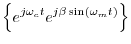 |
||
|
re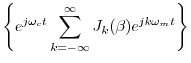 |
||
|
re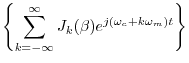 |
||
|
![$\displaystyle \sum_{k=-\infty}^\infty J_k(\beta) \cos[(\omega_c+k\omega_m) t]$](http://www.dsprelated.com/josimages_new/mdft/img545.png) |
(4.9) |
where we used the fact that
 is real when is real.
We can now see clearly that the sinusoidal FM spectrum consists of an
infinite number of side-bands about the carrier frequency
is real when is real.
We can now see clearly that the sinusoidal FM spectrum consists of an
infinite number of side-bands about the carrier frequency  (when
(when
 ). The side bands occur at multiples of the
modulating frequency
). The side bands occur at multiples of the
modulating frequency  away from the carrier frequency
.
away from the carrier frequency
.
Next Section:
Phasor
Previous Section:
Bessel Functions