Ideal Spectral Interpolation
Using Fourier theorems, we will be able to show (§7.4.12) that
zero padding in the time domain gives exact bandlimited interpolation in
the frequency domain.7.9In other words, for truly time-limited signals  ,
taking the DFT of the entire nonzero portion of extended by zeros
yields exact interpolation of the complex spectrum--not an
approximation (ignoring computational round-off error in the DFT
itself). Because the fast Fourier transform (FFT) is so efficient,
zero-padding followed by an FFT is a highly practical method for
interpolating spectra of finite-duration signals, and is used
extensively in practice.
,
taking the DFT of the entire nonzero portion of extended by zeros
yields exact interpolation of the complex spectrum--not an
approximation (ignoring computational round-off error in the DFT
itself). Because the fast Fourier transform (FFT) is so efficient,
zero-padding followed by an FFT is a highly practical method for
interpolating spectra of finite-duration signals, and is used
extensively in practice.
Before we can interpolate a spectrum, we must be clear on what a
``spectrum'' really is. As discussed in Chapter 6, the
spectrum of a signal  at frequency
  is
defined as a complex number
is
defined as a complex number  computed using the inner
product
computed using the inner
product
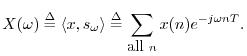 is the unnormalized coefficient of projection of
onto the sinusoid
is the unnormalized coefficient of projection of
onto the sinusoid  at frequency . When
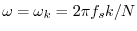 , for
, for
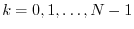 , we obtain the
special set of spectral samples known as the DFT. For other values of
, we obtain spectral points in between the DFT samples.
Interpolating DFT samples should give the same result. It is
straightforward to show that this ideal form of interpolation is what
we call bandlimited interpolation, as discussed further in
Appendix D and in Book IV [70] of this series.
, we obtain the
special set of spectral samples known as the DFT. For other values of
, we obtain spectral points in between the DFT samples.
Interpolating DFT samples should give the same result. It is
straightforward to show that this ideal form of interpolation is what
we call bandlimited interpolation, as discussed further in
Appendix D and in Book IV [70] of this series.
Next Section:
Interpolation Operator
Previous Section:
Zero Padding Applications